Friday, 9 September 2011

Percusize Me! is now one year old.

On a day like this of 2010, Percusize Me! started its life on the blogosphere with a post entitled Welcome!

During this year I have tried to show my inquisitiveness with respect to Music, to share ideas with my colleague percussionists and to demosntrate the general public the passion I feel for my profession.

To conmmemorate this first year, there´s a prize draw for two DVD´s for those who send me their email addresses to info@david-valdes.com. The prize is a DVD containing the concert that, on January 29th, 2010, the Gijón Symphony Orchestra, together with the Orfeón Donostiarra, gave at Teatro Jovellanos. The work performed is Verdi´s "Requiem", with soloists Svetla Krasteva, Lola Casariego, Mario Malagnini and Martin Tzonev under the baton of Óliver Diaz. 


What are you waiting for? Send me those email addresses!


…et in Arcadia ego.
© David Valdés

Saturday, 3 September 2011

Technique vs. musicality.

One of the most stupid questions I am asked (and, sadly, it´s done by musicians) is the classic "What do you prefer: having a good technique, or being musical?" There´s only one other question as silly, often asked by a fat lady while pinching your cheek: "Who do you love the most: daddy, or mammy?" 

Obviously, this question is vitiated from start:

1. Why do I have to choose one of those two options? Is it not desirable to have BOTH a fantastic technique an a vivid musical imagination?

2. In 100% of the cases, the question comes from musicians with deficient technique.

3. For the previous reason, the question is oriented for the answer to be the one the technique lacking musician wants to hear: that the important thing is musicality.


Photo by Vintage drum, catalogues and accesories

There are myths and misunderstandings regarding technique and musicality we have to get rid of NOW.

For many people, musicality is something you are born with and, the same "quantity of musicality" you are born with, the same you die with. For those who think this way, he who is born "musical", doesn´t have to worry about how to make music, as that´s something he has "inside", and comes out with no effort. Of course, defenders of this theory (what a coincidence, all of them happen to consider themselves "musical" people!) don´t get to understand you can learn how to make music. Obviously, talent and natural predisposition is part of the equation but, if those gifts given by Nature at random are not perfected, they will stay as mere potencial and won´t blossom to make a magnifient musician.

There´s no doubt Carl Lewis had talent and natural predisposition, but wouldn´t he had work very hard, he wouldn´t have won 10 Olympic medals and 9 WC ones. Thus, he considering himself "musical" (I would like to see his "musicality"), will do well improving his gift, and not think he´s got a rough diamond into his chest which will come out everytime he wants to, and without working on it. Of course, the other posibility (no talent, but hard work) exists, but tends to be fruitless. We have, then, these possibilities:

a) No talent + no hard work. Obviously, this brings nothing good. From this combinaion we can only expect disastrous musicians.

b) No talent + hard work. We can expect few from this case. Sadly, good will and effort (fantastic virtues) are not enough if they are not accompanied by something more. This combination produces mediocre musicians.

c) Talent + no hard work. This is a peculiar case which drives nuts those in case b): we all know people who, almost doing nothing, get much better results than those expending much more hours on the instrument. Obviously, this produces better musicians than b), but they are incomplete, as their talent is not taken further through hard work.

d) Talent + hard work. Of course, this is the combination producing the true musician. I don´t think I have to explain what´s evident.

Photo Deborah Smith Music

Other nonsense we normally get to hear is of this kind: "He´s a musician with a very good technique, but he is very cold". That´s the kind of justification given by a musician who, obviously, has not the technique of the one he is criticizing. As in everything in life, there are musicians with great technique being more or less expresive, but linking "technique" to "coldness" is such an stupidity that I will employ no time trying to dismantle that relation.

Photo Dulcie Holland

The alleged musicality of those reviling technique is nothing more than oversized ritardandi, excessive phrasing, very slow (due to the lack of technical control) tempi, inflated long notes... Sadly, many people think their kitsch, affected and mannered interpretation is "musical", but no... It is KITSCH, AFFECTED and MANNERED. We have, thus, musicians who revile technique and promulgate "musicality", but their alleged musicality is nothing more than something kitsch and mannered (so, in reality, they have nothing at all).

The reason why I think the question that gives cause to this article is stupid is because, he who is asking it, thinks that one can exist without the other, and THAT´S NOT TRUE: musical expresion can never be more than commensurate with technique, and every student with a normal intelligence has no problem at all developing both at the same time.     

When musical imagination triggers those muscular reflexes we have been working on for so many years, it gets a response from our fingers, wrist, arm..., and all we want to express flows from brain to instrument with no impediment. What happens when those muscular reflexes (technique) do not exist? Our fingers, wrist, and arm cannot respond, due to the lack of conscious technical work, to the demands of our brain; so, in between brain and instrument there´s a bottle neck preventing musical expression.


Technique without musical expression is a possibility to be guarded against; having said this, we all know "circus players" which do not transmit much emotion, but there they are: earning a living (with much success in many cases!). I still don´t know a musician allegedly "musical" with scarce technique managing to pay his mortgage.  On the other hand, artistic musical expression (real one, no mannered stuff) without a substancial technique is an impossibility, as the finest shades of musical meaning require the finest shades of technical control. Thus, separating technique from musical expression (and viceversa) is a fallacy, as one cannot be understood without the other, one is commensurate to the other, and both can be taught. 

So, next time you are asked that damned little question, answer BOTH, and you will also get an idea of the horrendous mental mess that asking person has.


…et in Arcadia ego.
© David Valdés

Tuesday, 9 August 2011

In memoriam David Searcy.

Sadly, I´m writing again mourning a loss. David Searcy has passed away on August, 2nd.

David was timpanist for the orchestra of Teatro alla Scala in Milan (before that, he played for the Bergen Philharmonic), a magnificent musician, and an excellent person. He was also a faculty member at the Royal Academy of Music in London, where I got master classes from him.


His knowledge of the operatic repertoire was enormous, and his ideas on editing notes were a major influence on me.

Rest in peace.


…et in Arcadia ego.
© David Valdés

Wednesday, 13 July 2011

Teddy Brown, a xylophone virtuoso.

As a percussionist, I always thought George Hamilton Green was the paradigm of the xylophonists, the virtuoso par excellence. His book is the Bible of the instrument, containing concepts I have incorporated to my playing (keeping wrists very low, using the edge on the accidental bars...). He was a prolific composer, a magnificent player and a successful teacher.


© Meredith Music

Apart from George Hamilton Green, my "xylophonistic radar" engaged George Lawrence Stone, Bob Becker, and few others. Recently, and thanks to the magic of the Internet, I have discovered a fantastic player: Teddy Brown.

Abraham Himmelbrand (that was his real name) was a man of rotund appearance, multi-instrumentalist, with an extraordinary musical talent, who played xylophone extraordinarily well.

A few videos:


See the ease on his playing, the use of the edge on the accidentals (magnificent that lateral shot), how low he keeps his wrists, those one handed scales.. A true virtuoso!


On this last video, he makes difficult things look easy, so confident... This song is quite cheesy, but makes me want to sing "walking in a winter wonderland".

Apart from being a terrific xylophone player, he was an amazing snare drummer. See his left hand on 0:25 onwards!


Here he is playing both instruments:


Teddy Brown: a natural talent and, sadly, not known among percussionists. Maybe, it was his premature death at 46, together with the fact that he left no legacy in the form of a book (something George Hamilton Green did) that condemned this player to oblivion.


…et in Arcadia ego.
© David Valdés

Friday, 8 July 2011

Tambourine technique II.

After some months away from the blog, I´m back again. As you already know, I have a passion for the sea and navigation. This months I´ve been studying and preparing my exam for becoming the Spanish equivalent to the RYA Yachtmaster Ocean, and I have passed 100% of the subjects I was enrolled in: Metereology, Oceanography, English and Radiocommunications.

Now that I have more time, I can write on the blog again... There we go!

Sometime ago, Ronny Lauten, follower of this blog, read my previous article "Tambourine Technique". As I wrote about a technique suitable for piano passages, Mr. Lauten got in touch with me, wanting to know my approach to loud ones.

Well, when I play forte, I use the same technique. When you want to play intrincate and loud passages, everything explained on that previous article is of application. Re-read it, as it has very detailed information. The only difference beween piano and forte is the velocity of attack. As my students already know, I always relate dynamics and velocity of attack: More speed always means more volume, less speed implies less volume.

On this video, you can see and hear that technique on loud passages:


This technique is very useful for things like "Capriccio Spagnol", "Carmen", "España"... It has many applications and, as it happens with its piano counterpart, it allows for the instrument to be played high, keeping the visual factor.

Many percussionists use the knee technique for these situations. Personally, (not neglecting any other way of playing, as different situations can be better resolved with certain technique instead of other), I prefer to unify criteria and play everything as simple and natural as possible. If I can play an excerpt this way, I prefer it over the knee version, as I can stay seated (read "To sit or not to seat? That is the question") and keep the instrument high.

As you can see, this technique can be used with many passages.

But... What if we need to play agile passages  with very generous dynamics ("Trepak" comes to mind)?  For this, I use a very similar technique. Our thumb may not be enough for dynamics above forte (quite logical as it´s only one finger), so I use a group of muscles located on the base of the palm named thenar and hypothenar prominences. It will be the red marked part the one replacing our thumb, allowing to play louder:


© ASSH


This technique is very similar, but presents slight differences.

Our fingers strike exactly the same: they hit the tambourine in the same way we already know.


© David Valdés

The difference is in the way we hit with the palm. Contrary to the way we used the thumb, which striked the instrument, it is the tambourine which produces the stroke: the right hand stays still (very important), being the tambourine with a left hand twist the one producing the stroke:


© David Valdés

Obviously, it´s crucial for both types of stroke to be as similar as possible, resulting in a homogeneous sound. The "work load" is for the fingers, and the "extra strokes" are assignated to the base of the palm.

On the following video, you can see the different movements:


I encourage you to practice these techniques for their extraordinary versatility.

These are just a few of the many possibilities the tambourine has to offer. In future articles, I´ll write some more about different techniques for this instrument.


…et in Arcadia ego.
© David Valdés

Sunday, 3 April 2011

To sit or not to sit? That is the question.

Today, I´ll write about something that may make no sense out of Spain, but I´ve been asked about it quite a few times: In the orchestra, should I stand up or sit down when playing?


In Spain, the usual procedure is to stand up for playing cymbals, bass drum, triangle, tambourine, xylo... In my particular case, I have never asked myself why, but as it was what I always have seen, I simply stood up for playing.

It was not until I moved to London that I started questioning this method. The first work I played with the orchestra at the Royal Academy of Music was Strauss´ "A Hero´s Life", and I was in charge of tam-tam, cymbals and triangle. When I stood up to play my first entrance, the whole section looked at me and made funny faces. As soon as I finished, the principal asked me: "Why are you standing up?" Very secure of myself, I told him all that stuff about the visual thing, the theatrical component, that a concert is also seen, apart from listened to... He smiled and told me to do whatever I fancied but, in the UK, that was quite extravagant.

Few days after I attended my first concerts, and I realized that the whole section was sitting down.

I asked my teacher, and his explanations convinced me.

There´s no other member of the orchestra (except for the conductor) standing up for playing. When a player stands up, is calling attention to himself, announcing in a very visual way to the audience that he is about to do something: "Hey, look at me, I´m standing up so you can see I´m about to hit something!"

Standing up, you are calling an unnecessary attention to yourself and to the entrance you are about to play, which shouldn´t have it: No other player makes such a pompous announcement. The important thing is Music, not your next entrance, so boldy announced when you stand up. When you do so, you also take the risk of making extraneous noises (cracking floors, noisy chairs...).

You can keep the visual aspect keeping your instrument high, showing it to the audience (the old saying "if you can´t see it, you can´t hear it" is still valid), but not taking the theatrical aspect so far that it gets over-important.

Since my London days, I play sitting down. There are very few occasions when I stand up. This way, I do not call attention to my next entrance, and give the importance to the Music, not to me, the chap who is standing up, distracting the audience, calling for attention, focussing the interest, and making the members of the audience say "look, look... He´s standing up, something´s about to happen!"

As you can see on the first video, I play cymbals (both clashed and suspended) sitting down on a high stool, right at hip height: This way, my height is almost the same standing and sitting, not calling attention to myself.

You already knnow the following video from the post "Tambourine Technique", but it illustrates very well my purpose: I´m playing sitting down, but maintain the visual aspect keeping the tambourine high.


Same thing with bass drum... There´s no need for standing up. I can play everything while sitting down, no extraneous moves...


I can assure you none of the section principals nor conductors I have played with, have ever complained about me sitting down while playing. Try it: Sit down, don´t call attention to yourself, keep things nice and easy, no complicated stuff... As they say, KISS! (keep it simple, stupid!).

Jesus told Lazarus to "stand up and walk!". I tell you to "sit down and play!"


…et in Arcadia ego.
© David Valdés

Saturday, 19 March 2011

Mostlymarimba.

I can´t deny it: many of you know how much I admire Leigh Howard Stevens, his work, the way he makes music, his sense of humor... Having said that, I have to admit his presence on the cyberspace was frankly poor, as his website was not updated for a vey long time (years, maybe).

Today, I was very pleasantly surprised when I discovered Malletech has renovated its website, which looks like this:


© Malletech

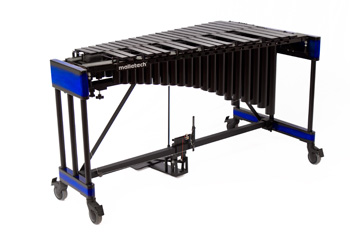
It has many new sections, and much more developed than before. Thre´s a meticulous description of all instruments manufactured by Malletech, including its new vibraphone. Yes, ladies and gentlemen... What everybody was anxiously waiting for (at least me!) is now a reality: Malletech does make vibraphones!


© Malletech


There´s a section devoted to their mallets, arranged by series or instrument, all their music catalogue and recordings, artists, events and news... Everything related to Malletech, Resonator Records, Kp3..., has a presence on the new site.

The best thing is the new educational section, which includes videos and articles, and carries on with the formative side of my favourite section from the older site: "For Marimba Geeks".


© Malletech

Because this new site has been on line for only a few days, it still has some things that need to get fixed, but I´m sure they will be improved soon.

After so much time neglecting their web presence, it seems that, at last, Malletech has pulled up its socks, and I have received their decision with joy... They even have a YouTube channel and a FaceBook account!


I´m really looking forward for the new site to be full of new content.


…et in Arcadia ego.
© David Valdés