"Samson and Delilah", by
Camille Saint-Saëns,
is an opera premiered in 1877 containing some interesting percussion parts. So, the glockenspiel in the 3º scene of the 3º act is a usual suspect in audition lists, the timpani part in the "Bacchanale" is a good one (and also an occasional visitor to lists), the triangle in the finale, altough not particularly difficult, is fun to play... But, if we have to point the one that has attracted the most attention to itself, that´s the "castagnettes de fer" part in the
"Bacchanale". This article will deal with it (you can download the part free and legally
HERE).

In this bacchanale, which connects with the French tradition of adding dances to operas and happens right before the dramatic ending in which Samson demolishes the temple by pushing two columns, wooden and metal castanets are asked for ("de bois et de fer"). No problem at all with wooden ones, as that´s what percussionists have been using for centuries (millennia!), but metal ones have been causing trouble since the very moment this opera was premiered, as this is not a traditional instrument nor it is asked for in any other work of the repertoire (none at all!).
I have seen finger cymbals being used (which makes total sense, as those would be the instruments used by dancers in the Middle East during biblical times):
 |
| ©Amazon |
In fact, in Filippo Bonanni´s "Gabinetto Armonico" (Roma, 1722) there´s a specific mention to naccare being played by bacchants ("a woman taking part in bacchanales"):
"She [the bacchant] is holding a couple of little metal bowls in both hands, which they are struck one against the other, and with their beating pagans gathered in dances honouring the gods". I can´t think of a better description of what´s going on in the opera at that precise point... 😉
 |
| "Gabinetto Armonico" (F. Bonanni, 1722) |
I have also seen Moroccan qraqebs, qaraqebs or qarkabas being used:
I find any of these two options perfectly fine for playing the part (specially the first one). But... Should we decide to stay true to what Saint-Saëns asked for, want to use the original instrument and be historically correct, none of them is the one... The answer to the mistery is in a book entitled "Méthode de timbales et Instruments à Percussion", by Joseph Baggers.
Baggers
was born in Antwerp in 1858 and died in París in 1938. He was timpanist for the Théâtre National de l´Opéra-Comique and for the Société des Concerts du Conservatoire, and also taught at the Conservatoire National de Musique et Déclamation (he was the percussion teacher of a very young
Olivier Messiaen).

Baggers
knew his stuff because, when "Samson and Delilah" was, at last, performed at the Opéra National (it was premiered in Germany fifteen years before, as the biblical plot was considered not of the interest of the Frech audience), Saint-Saëns himself supervised the production, which was conduct by
Édouard Colonne,
one of the "stars" that, at the beginning of the book, praise the good job done by the author. In addition, Colonne addresses Baggers with affection and familiarity, which indicates they knew each other. Have you read "Monsieur Crochet antidiletant" (C. Debussy)? If yes, Colonne and his concerts may sound familiar to you. Even more,
Debussy
is also one of the authors prasing Baggers´ job at the beginning or the book. I don´t know whether Baggers played or not on that particular occasion but, it is quite clear that, at least, he had first hand information from Colonne.
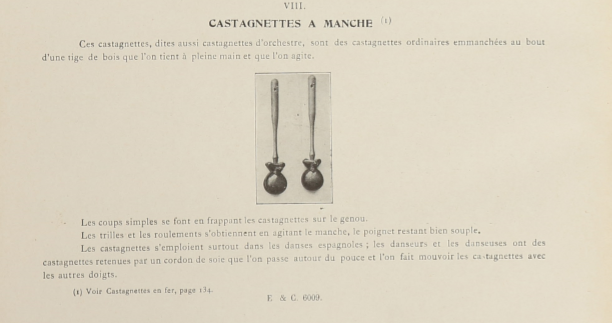
So, on page 134 we can find the following:
"IRON CASTANETS.
This little used instrument (Saint-Saëns, Samson and Delilah), is played like the normal castanets".
Well, we have a problem here... This instrument can´t be played like "normal" castanets because "normal" castanets are not connected together by a "U" shaped handle. So here we have what´s a normal thing in the orchestral world: a trick, a machine, a way to play castanets (whether they are made of wood or iron) which facilitates playing them without having to use their consubstantial technique.
Here you have it... On page 122 we can find what Baggers considers "normal" castanets:
On the last paragraph he mentions what I do consider "normal" castanets: those played hanging from the thumbs.
Baggers states that that´s how dancers play them, but he names "orchestral castanets" (therefore the kind he would have used) those with a handle. Pretty obvious that, if his wooden castanets were furnished with handles, so his metal ones (as we have already seen).
So? With the solution by those percussionst unaware of the proper traditional technique, one saves time acquiring it (but that´s a personal "war" of mine, forget about my insistence on this particular topic 😉).
Now, go back to the photo where Baggers proudly poses with all those instruments... That makes me think that arsenal is his personal collection (or, maybe, they belonged to the orchestra which, at the time of the book being printed, he was playing for. I´m up for the first option). Right opposite the timps we can see a pair of wooden castanets (those to the left of the spectator, as we can see the central clapper against which the two shells would have hit) and the metal ones (those to the right, as there´s nothing in between them, both hitting directly against each other).

I can´t positively confirm whether Baggers played "Samson and Delilah" or not on that particular occasion, but one thing´s for sure: he and Saint-Saëns had common friends and colleagues, and Baggers mentions the xylophone and "Danse Macabre" (the xylo appears in the group photo and is described on page 133), so chances are they knew each other and worked together. It is something quite common: a composer approaches a specialist asking for advise, and said specialist goes: "follow this path, don´t follow that one, that´s easy, that´s hard, write this, write that, use this instrument, don´t use that one...".
Im guessing... Probably, Saint-Saëns saw some of Baggers´ instruments and decided to include them in his scores. Maybe it was the other way round: Baggers saw what Saint-Saëns wanted and approached him saying "why don´t you use this cool thing I have here?" Very often, composers write with the orchestra (thus its instruments) which is going to play/premier a work in mind. This, when using uncommon instruments, is a problem when different orchestras play that same work, as they may not have the instrument or may be unconnected to a particular tradition (remember that´s the case with Bartok´s
"Bluebeard").
We must remember that
Wagner had already scored for castanets in the Bacchanale of
"Tannhäuser".
"Samson and Delilah" was premiered in Germany, so the castanet requirement by Saint-Saëns wouldn´t have been strange to German percussionists (as a curiosity, both parts share the one 8th-two 16ths rhythmical pattern. Did Saint-Saëns castanet writting find inspiration in Wagner´s?). Maybe, when "Samson" was played at the Opéra
National, Baggers approached the composer and told him "see what a cool toy I have here... Why don´t you add it to the apart the Germans have already played?" Or, maybe, Camille saw Baggers´collection, approached him and said "you have a nice toy there... I may use it, it may be cool". And that is something I would really love to know: was there a castanet part (wooden) used in Germany at the premiere and another different one (wooden plus iron) used at the Opéra National because of Baggers´ influence? Musicologists, you have an assignment here... 😉
My humble opinion is that, when it comes to authenticity, historical and musicological exactitude, the best option to describe the musical context in the Middle East during biblical times would be the finger cymbals one (the one refering to bacchants), as it fits perfectly. But, whether we like it or not, should we want to be true to the original part Saint-Saëns himself supervised at the Opéra
National, we must use the instrument described on page 134 of Baggers´ book. Good news is there´s an instrument maker in the UK (
Matt Nolan) who, based on the photos in the book, makes a perfect replica of this instrument:
 |
| © Matt Nolan |
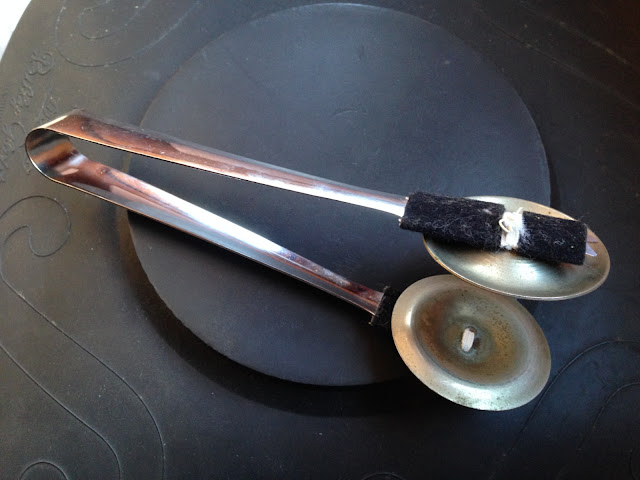
Surprisingly enough, Rafael Casanova (principal percussion,
OSPA,
and my former teacher) got to a very similar and clever solution using ice tongs with a couple of finger cymbals attached to both ends. That´s how we played the part when
Ópera de Oviedo staged "Samson and Delilah" in the 2015 season.
 |
| © Rafael Casanova |
You now know the mess you will get into should you have to play this opera 😉. I´d love to know what´s your solution for the "castagnettes
de fer". Tell me!
This article is dedicated to David Vatteville for his kindness and generosity.
…et in Arcadia ego.
© David Valdés