Showing posts with label Side Drum. Show all posts

Saturday, 15 May 2021

My home-made Renaissance side drum.

A side drum is an ancient kind of large drum that was used in Europe by the landsknechts, mercenaries from the German area. Said troops fought on the side of the highest bidder, and they even were part of the Spanish infantry under emperor Carlos I.

Said drum was played to one side, under the arm pit, thus its name. It was played together with fifes and was used to march, transmit orders, entertain the soldiers...


This project starts with a 18"x18" Gonalca surdo which was crying for a new chance.


© David Valdés


I took all the hardware and the wrap off, leaving the shell in its "natural" state.


© David Valdés


18"x13" seems to be a normal size for these drums, so I cut the shell to nearly 14" in depth.


© David Valdés


Quite obviously, I kept the remainig shell, which is now an instrument I will write about in the future. Now it was time to cover the holes...


© David Valdés


...and to cut the protuding dowels.


© David Valdés


I sanded both sides of the shell so they were smooth and then glued a new veneer:


© David Valdés


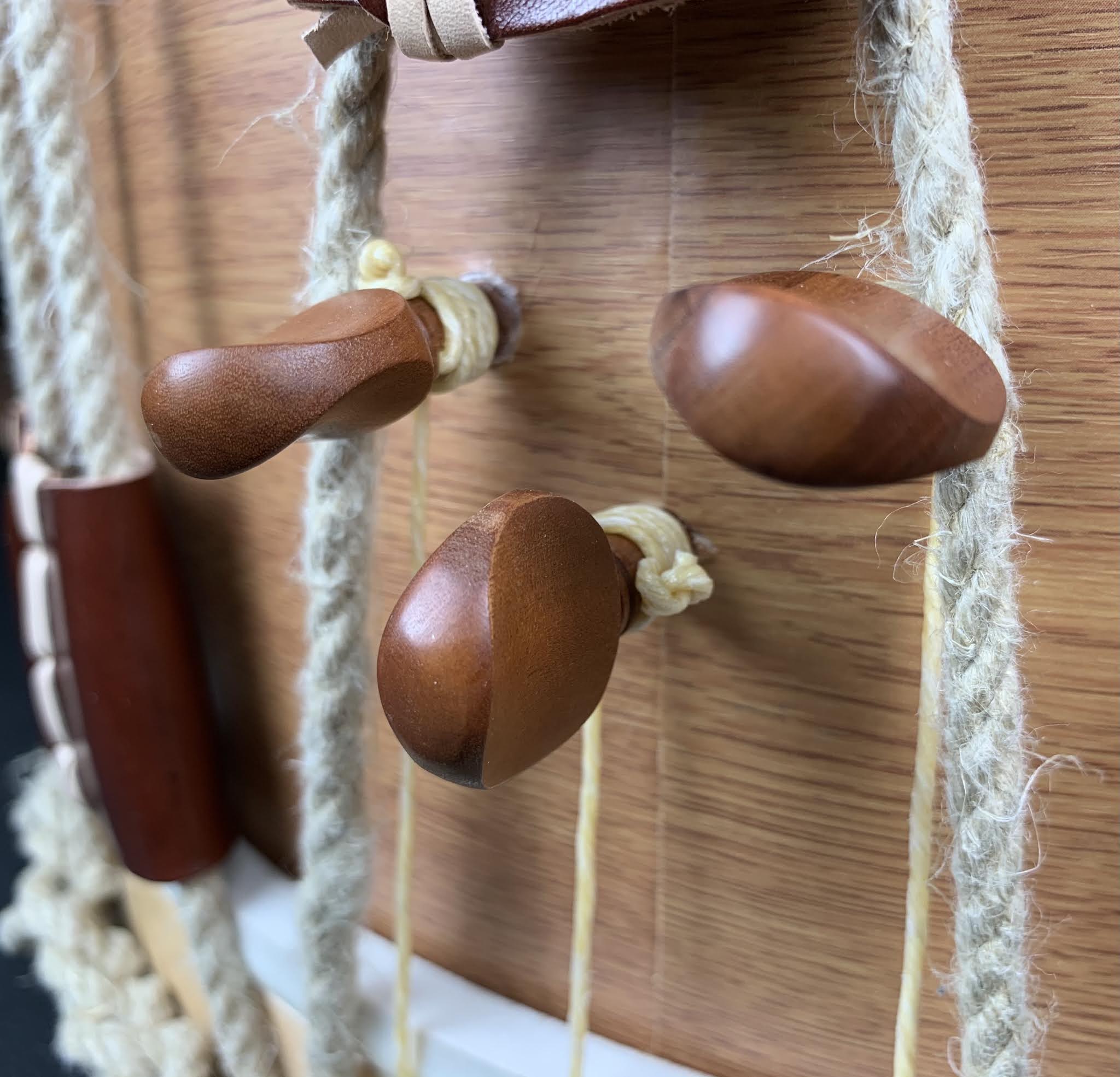
The shell was ready. I then drilled two diametrically opossed groups of three holes to accommodate the pegs in charge of tensioning the snares. Six viola tuning pegs were inserted, which I drilled so the gut could pass through:


© David Valdés


I got two wooden counterhoops at Thomann, which I drilled (16 times each) at a 22.5º angle to facilitate the passing of the rope.


© David Valdés


I cut two snare gates in the resonant counterhoop for the snares:


© David Valdés


I made 16 ears using leather pads and ribbon:


© David Valdés


Everything was ready: the 16 ears, 22 metres of hemp rope (7mm. thick) and two goat heads (the batter one slightly thicker, both mounted on wooden flesh hoops) I got at Baena Sonido.


© David Valdés


Here you can see the pig tail, the knot that ends the roping and keeps the tension. See how the ends of the rope are covered with leather tape so they do not fray:


© David Valdés


A chain is "knit" with the remaining rope, which is attached around the lower counterhoop. This is how the drum looks like once roped:


© David Valdés


I made the snares using natural gut I also got at Baena Sonido.


© David Valdés


I passed the gut through the hole I previously drilled on the pegs, securing it with a figure of 8 knot (the gut was wet, so it was malleable and easy to work with).


© David Valdés
 
 
© David Valdés


© David Valdés


As a last detail I added to rope loops, which will be used to secure the cotton sling I will use to hang the drum from my right shoulder. See how the ends of the rope are covered with leather tape:


© David Valdés


This is how the finished drum looks like:


© David Valdés


© David Valdés


© David Valdés


© David Valdés


© David Valdés


© David Valdés


© David Valdés


© David Valdés


© David Valdés


© David Valdés


And this is how it is played:


© David Valdés


© David Valdés


Stay tuned, as I will soon publish a video featuring this drum. As always, I will be more than happy to listen to your comments, advises, opinions...


…et in Arcadia ego.
© David Valdés

Sunday, 17 October 2010

Radio memories.

Believe or not, there was no TV at home when I was a child (late 70´s). We still had to wait sometime before an old tubes television took possession of our living room (turning it on was a tedious task, as tubes took quite a long time to heat, and switching it off produced a charasteristic fade to black, with a funny "phiuuuuuuuuuuuu" noise). It was B/W (a colour TV was an oriental luxury), and it had no remote control (at that time, in Spain, we had only two channels -UHF and VHF-, so even having it, wouldn´t have been of much use). When "technical problems" arrised, an attentive fist, well closed, would gracefully hit its top, converting a blurred image into your favorite program.


But I´m digressing... At that time, we had no "goggle box".

During luch time, my father used to put a small radio receptor on the table, which he used to listen to the news. As a jingle for RNE (Spanish National Radio), there was a tune that got stack into my memory, a melody that always seemed very sad to me, and made me imagine the tree-lined walk at Isabel la Catolica Park in Gijón in autumn, the ground full of brown leaves... Even for me, a child five or six years old, that music was sad.


The thing is I´ll never forget that jingle... There are certain things that, during your chilhood, get into your head and, no matter how much time passes by, we never forget them. Many times, they are there, in a latent state, we not realizing their presence and, suddenly, a spark brings back those memories, making us to live past times again...

I still whistle that tune note for note, and associate it to an image in which my father is sitting at lunch time listening to the news on his small radio (a receiver I don´t know where it is -maybe lost many years ago-, but I still clearly remember).

Because of the almost infinite possibilities of the internet, I searched for that tune, but could never find it.

Untill few days ago, I had to use my "hard drive" and just remeber it but, at last, I could find it (I´ll tell you how, because that´s the interesting point of it).

You can hear the tune I´m refering to from 0:50 on (the one orchestrated for strings and harpsichord):


If you have read my post "Spanish military drums", and have realized the martial character of the first melody, I´m sure you already know what the explanation for this tune is...

Yes! It´s a fifes and drum tune we can find in the 1761 manuscript by Manuel Espinosa that can be found at the Spanish National Library and I talked about in my post "Spanish military drums".


Just imagine my surprise when, whisteling the various tunes the booklet contains, I found "La Generala" is the tune used by RNE for the jingle which brings so much memories back to me. With that information, finding an audio archive was a piece of cake.

You may have noticed that the orchestrations by RNE are adding a bar at the end in order to get perfect 8 bars phrases, instead of the double seven bars phrases in the original.

According to the Royal Orders by HRH Carlos III, "When all the infantry serving in the same place, whether it be a garrison, barracks or field, had to take arms for marching, review, exercise or whatever other function, as a prevention, La Generala has to be played".

You can hear the fifes and drum version HERE (column on the right, second from the top). Again, the discrepancies you can hear between music and score is due to the 1769 version being played, instead of the 1761 one.

For the second time, looking for information on the Spanish military drum tradition, a very familiar tune came accross. This one is intimately tied to wonderful and unforgettable memories from my childhood.

In memoriam Secundino Fernández Vigil.


…et in Arcadia ego.
© David Valdés

Tuesday, 12 October 2010

Spanish military drums.

It´s a concidence, but today, Day of the Spanish Armed Forces, my post is about military music and drums.

As a percussionist, I have studied Swiss (Bassler Trommel), French (Batard, Coup de Charge, Coup Anglais, Moulin, Coup du Rigodon...), German (Druck Ruf,  Schleifschlag, Französischer Ruf...), Dutch (Lange Voorslag, Dubbele Slagen, Verwisselslagen...), Scottish and American drum rudiments. I know the 40 PAS rudiments, and the endless possibilities the Hybrid Rudiments have to offer... Sadly, and despite it been a contradiction, I know nothing about the Spanish drumming tradition.

As we know, the origin of the drum is, no doubt, military, and because of the Moor Invasion during the early Middle Ages, Spain was the fist European country to get to know the instrument. The  tabor (atambor, atabal) soon found its place in the military world and, if we have into account that Spain ruled the world during some centuries, we have to assume the drum took a very important role in the most powerful military force at that time (also, Spanish kings paid Walonian and Swiss mercenary forces, being the latter those who iniciated the rudimental tradition).

For all these reasons, we can conclude that, despite being quite unknown nowadays, Spain must have had an important military drumming tradition.

This is what I´ve doing lately: investigating and studying everything related with our national tradition, and future posts will be dedicated to this issue.

In the meantime, I´d like to share with you some of my "little discoveries", which show me that we have military music more assumed that we think.

Thanks to the Spanish National Library, I got a facsimile (there´s just one copy left) of the following "Libro de la Ordenanza Delos Toques de Pifanos y Tambores Que se tocan Nuevamente en la Infanteria Española Compuestos por Dn Manuel Espinosa 1761". Translated, would be something as "Orderly book containing the beats newly played by the fifes and drums in the Spanish infantry composed by Mr. Manuel Espinosa 1761".


We can corroborate the close connection between fifes and drums in the infantry, as opposite to the connection between trumpets and timpani associated with the cavalry (the trumpets/timpani association remained once these instruments got into the orchestra).

In this booklet we can find a Retreta (retreat). In the 1769 Royal Orderly Book by HRH Carlos III (which was revoked as late as 1978!), it is stated that the Retreta is to be played "when the General in charge decides that it´s time for the troops to retire to their tents or barracks at the sunset. In march, it indicates when the column has to turn left". I´m sure it sounds quite familiar to you:


You can hear it, played by a "banda de guerra" (war band):


The little discrepancies you can hear between the interpretation and the score is because they are using a later version (1769). This eight years younger edition is kept at the Spanish Royal Library.

Luigi Boccherini, who lived and died in Spain, obviously heard this retreta, and literally quoted it in his famous work (performed by the Boccherini Ensemble):


In the twentieth century, Luciano Berio wrote his own version:


Berio orchestrated his work in a very intelligent way, as he uses snare drum ostinatos, and the first instruments to play the theme are the flutes, which takes us back to the origin: fifes and drums.

A more recent version is the one by David del Puerto. You can hear the Gijón Symphony Orchestra live on February 7th, 2009 at Teatro Jovellanos in Gijón under the baton of Óliver Díaz, with Rafael Casanova on baroque timps (the same instruments I mentioned on the article "Baroque timpani restoration"): 


This version, which uses timpani instead of snare drum, doesn´t convince me from a historic point of view.

It´s funny to see that a theme we normally associate with Boccherini is, in fact, from Manuel Espinosa... It may even not be from Espinosa himself, being he a mere compilator of an already existing military tune.

The Spanish military music catalog is full of fantastic surprises... Gradually, I´ll tell you about them.

(I´d like to thank Manuel Mefre González for his invaluable help and guidance).


…et in Arcadia ego.
© David Valdés