Showing posts with label Various. Show all posts

Friday, 4 May 2018

"Armonica a bicchieri" in Donizetti´s operas.

There´s a video which has become quite popular among percussionists in the last few days. It features a rehearsal of "Lucia di Lammermoor" at the Metropolitan Opera; more precisely, the famous "mad scene" ("Il dulce suono...", act III, scene 2). The curious thing about it is the historically informed approach, as the famous flute solo is played on the instrument it was originally scored for: the "armonica a bicchieri" (harmonica made of glasses). The information you are about to read has been taken from the fantastic "The Timpani and Percussion Instruments in 19th Century Italy", by Renato Meucci, a book I wholeheartedly recommend.


The "armónica a bicchieri" is an instrument regularly present for more than a decade solely at the Teatro San Carlo in Naples. It´s made of musical glasses, rubbed with the fingers, and the most reliable description can be found in a treatise of 1846 by the Neapolitan Vito Interlandi:

There are different types, but that in use at the moment is composed of two octaves of glasses set in a kind of box adapted for this purpose, and tuned with more or less water in the glasses that are of different sizes, from C below the staff to C above it, an further still to high F, going beyond the two octaves according to the maker. The melody is played by the right hand and the bass by the left. The tips of the fingers, wetted with the water, rest lightly on the rim of the glass, and going round its circumference draw out the sound. The famous Franklin raised the status of this toy to an instrument in 1763. 

Interlandi adds that, at the moment his treatise was published (1846), the instrument was still used occasionally in the theatre since "...space must be left near the harpsichord for placing special instruments such as the harp, musical glasses, or others, when they are needed".

There are two Donizetti operas, both written for the Teatro San Carlo, in which the musical glasses are explicity requested: "Elisabetta o Il castello di Kenilworth" (1829) and "Lucia di Lammermoor" (1835). At least since 1833, among San Carlo´s orchestra musicians was an "armonica" player, the same Domenico Pezzi, for whom the Lucia part was written, but who, at the last moment, was not able to play it; thus the substitution in extremis that assigned to the flute one of the most famous solos in the opera repertoire of the 19th century.

According to Gabrielle Dotto, in his article "Voci celesti e scelte critiche", included in a hand bill of a production of "Lucia" by La Scala, in the autograph manuscript, in the particella for the armonica, there´s a note stating "cancellata ma ancora ricostruibile" ("cancelled, but still redoable"). Pezzi had rehearsed the part together with Taccchinardi-Persiani (the soprano who premiered the opera), but he was already having problems with the management of the Theatre, as another armonica part had to be cancelled in a previous ballet: "Amore e Psiche" (the part, profetically, being given to the flute). The Teatro San Carlo fired Pezzi stating he was not reliable, as cancelling the part in the ballet was due to him leaving the city without previous notice. On the other hand, Pezi, who was paid per gig (a pioneering freelancer), declared that the Theatre, in finacial difficulties, fired him so as to save on his emoluments. When asked by the Theatre what to do after firing Pezzi, Donizetti decided to substitute the armonica with "una coppia di flauti" (a couple of flutes). So, on September 26th, 1835, the night of the premiere, the armonica didn´t sound.

I´d like to add that the term "armonica" was also used to name an instrument made of small glass strips, played with mallets or, later on, with hammers operated by a keyboard ("armonica a tastiera"). These instruments had singular success in Italy, as proved by several examples conserved in private collections.

So, dear flutists, you now know this solo belongs to us 😉. 

I have played "Lucia di Lammermoor" several times, but no armonica was used due to it not being available. Wold you have imagined something like this?, would you like to play the armonica part? Tell me your thoughs.


…et in Arcadia ego.
© David Valdés

Tuesday, 13 June 2017

Rest in peace, Emma Maleras.

Today, at 97 years old, Emma Maleras has passed away. She may be unfamiliar for many people but, for those of us who care about castanets, she is a milestone. 


Emma Maleras created a method that approached castanets like any other instrument: with respect and rigour. She created the bigram, and her pianistic background proved to be priceless. She dignified the instrument and made it achieve soloistic category.

I didn´t get to know her, but I did buy and study her books. Thanks to them I left my ignorance behind, and my perception of the instrument changed for ever. I´m far (very far) from being a castanet vistuoso, but I´m on my way to being able to play castanets at least as well as I play other instruments I´m proficient on.

If you are interested in playing castanets the way they should be played, I encourage you to get her METHOD.    

In the following videos you will get to know this fantastic soloist, sadly unknown for the vast majority of percussionists.


Rest in peace. 


…et in Arcadia ego.
© David Valdés

Tuesday, 18 April 2017

Happy birthday, Ms. Abe!

Today is the 80th birthday of a person who has had a tremendous influence in the marimba world: Keiko Abe.


It is not the purpose of this article to detail her career, achievements or insist on the tremendous importance of her figure (everything already well known), but to wish her a very happy birthday on this very significant date and to remember the fantastic days of music making I shared with her almost fourteen years ago.

During my time in London, there was a specially hard week, as we had to prepare many works to play for her which would be recorded live. I prepared solo works by Japanese composers (Tanaka, Miyoshi, Abe...), and a chamber ensemble prepared "Conversation in the Forest III" and "Marimba Concertino The Wave", both by her.


"Conversation in the Forest III". Rehearsals at the Duke´s Hall

Obviously, we were spected to play at our best whic, together with Keiko´s never ending stamina, made for a very hard and demanding week.

After the concert

From that fantastic experience, apart from unforgettable memories, I keep a CD of that recital, a very precious possession of mine that I still play from time to time.

I also played some solo works for her. I got extremely surprised when, having finished with Tanaka´s "Two Movements", she asked me to start all over again... She joined me improvising a second part the one already written. I will remember that duo for ever.


Should you want to listen to a small fragment of that recital, you can do so on my website: MULTIMEDIA, audio tab. The second track on the player is the final part of "The Wave".

A very nice person, full with boundless energy, extremely polite and a rare musical talent. Happy 80th birthday, Ms. Abe.


…et in Arcadia ego.
© David Valdés

Tuesday, 12 April 2016

Muffling the bass drum in style.

Tried and true instruments/heads combinations exit... Oversized Ludwig Professionals (32", 32", 29" and 26") with REMO heads is a classic, as the Supraphonic/Emperor, Hardtke/Super Kalfo...
 
The more I play the bass drum, the more I realize this instrument doesn´t sound at its best when mounting plastic heads: they produce funny harmonics, resonate excessively, you can hear the sound of the material instead of that of the instrument, tone is always improvable... Calf heads make the bass drum sound good doing almost nothig but, in exchange, they present their own problems (changes in temperature, humidity...). I do accept these challenges because of the far superior sound these heads produce. So, to me, the tried and true combination when it comes to bass drum is that involving calf heads.
 
When plastic heads are the tool at our disposal, the usual thing is muffling the head using a hanging towel secured to the counterhoop with a clip. Playing with the amount of material lying on the head, we can control resonance and harmonics.
 
 
© David Valdés


On this photo you can see a towel hanging as previously described (the ones I use are from IKEA, dirty cheap and discreet on stage due to the black colour). Don´t mind about the length showed, as it´s just a "pose": I just clipped it for the sake of the photo. 

Last time I used this trick I had a problem: when playing, the free end of the towel moved up and down, shaked by the head, hitting it, acting as a snare and producing a very annoying buzz. Maybe the audience could not hear it, but it was driving me mad...

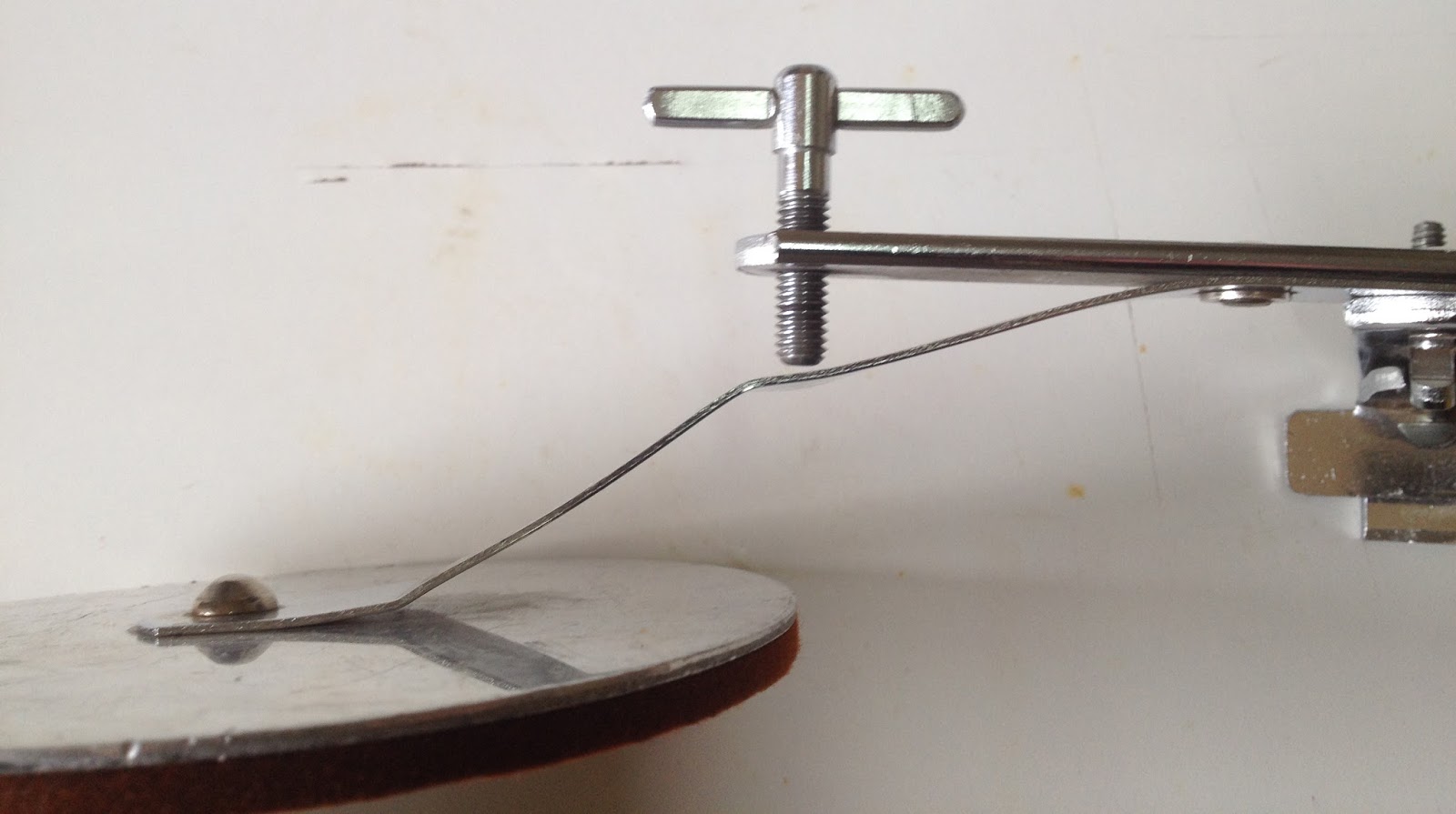
When thinking about solutions trying to solve the problem, get the instrument under control and get the best possible sound, I remembered a device used on vintage drum sets. It is a felt pad attached to a round plate with articulated arms which you can fix to the counterhoop. Using wingnuts you can control the pressure it exerts on the head and where on it (by bending the arm). You could see it mainly on bass drums, as the other drums on the kit used to have it inside.


© late8


I got one a few months ago. My intention was to not necessarily use it on a kit, but I knew that, at some point, it would come very handy for whatever weird purpose my mind would come up with. This is the one. It has no brand or inscription on it. Maybe a Ludwig? It´s 15cm in diametre and its arm is 25cm long. As with everything, you can go the expensive way if you get a vintage, fancy one, but you can get a modern one for a very fair price (STAGG).


© David Valdés


© David Valdés


© David Valdés


© David Valdés


© David Valdés


Here it is on the head, ready for some action.


© David Valdés


The muffler moves together with the head, you can press it more or less against it, there´s no play between them, you can move it closer or away from the counterhoop and it produces no buzz at all. It works flawlessly. Just one thing: its size is intended for bass drums no larger than 24", 26". As symphonic bassses can reach up to 40" in diametre, its surface may be not enough to get the desired effect on instruments this size. I would have loved some more control, but this device can be very easily modified to get more contact surface. Even that, I got rid of the buzz and the bass drum sounded very well.

A calf head is the best option for a bass drum (I think, in fact, it´s the only option) but, if not, the towell trick has proved (quite) its effectiveness. If the towell is giving you a hard time, this muffler is a fantastic solution to play your bass drum not only with control, but with some style...


…et in Arcadia ego.
© David Valdés

Thursday, 10 March 2016

"American in Paris" taxi horns: the end of a historical mistake.

There´s a buzz going through discussion groups and forums these last days that, far from calming down, is growing in a very noticeable way... The subject is not trivial, as it has "huge" consequences. An article in the New York Times reveals that the taxi horns we´ve been using all these years in "An American in Paris" (George Gershwin) were playing the wrong pitches.


© Jam percussion


The article, published on March, 1st (hot from the oven), has left no percussionist indifferent. HERE is a link to it. There you will find the conclusions of Mark Clague, musicologist in charge of the new critical edition of the score.You will also find a recording with the part as we play it today and the first recording of the piece (and the only one featuring the original pitches) by Toscanini and the NBC National Orchestra. Stop reading this blog, open the link and, before going on with Percusize Me!, read the New York Times article. The key is the A, B, C, D notation...
 
Have you already read it? If not, stop now and go for it... Done? Don´t tell me you are not petrified...

The conclusions in the article make much sense, but they gave cause to doubts, discussions and mistrust, as they could not be 100% proved due to the original set of horns being lost and because no photographs could definitely prove the A, B, C, D notation was not one related to musical pitches but to the order in which the horns were arranged for the recording. The commotion and controversy the article created about this "transcendental" issue enriched the debate, but every doubt and opinion got eclipsed when, on March 5th (only four days after the article shocking the Gershwinian foundations was published), the University of Michigan got the ace hiding up its sleeve that proved almost irrefutably its point. The link to that article is HERE. As before, stop reading Percusize Me!: open the link and devour it.


© Ira and Leonore Gershwin Trusts


What do you think? Incredible, isn´t it? This photo is the bombshell that proves we´ve been playing those notes wrong. It´s pretty clear looking at them that the size of the horns is not proportional to consecutive pitches (a, b, c and d), and that they are not even arranged following a size pattern, so the points made by Mark Clague are very valid.

Gershwin himself got those taxi horns during two different trips to Paris, got them arranged on a board the way we can see in the photo and named them A, B, C and D as ordinals, not as pitches. The pitches on the Toscanini recording are A flat, B flat, D (quite brilliant) and A natural (low octave).

Don´t know you, but I´m astonished about this revelation, and the points are valid. This is also the kind of curiosity mixed with academic rigour that, you should already know this, I like so much.

There are rental companies already offering this new set of pitches and percussionists willing to play them in future concerts. I would love to try this new version... What would you do?


…et in Arcadia ego.
© David Valdés