Showing posts with label Bass drum. Show all posts

Saturday, 13 August 2022

Modification of a Premier bass drum (1)

This project is a consequence of a larger one; namely, to provide myself with the proper drums to recreate as close as possible the original sound, character and looks in I. Stravinsky´s "The Soldier´s Tale".

For the bass drum I used a 28"x12" Premier (model 188) from the 70s. Here you have a photo from the catalogue and a technical description:


© Premier Co.

© Premier Co.


It was finished in "Burgundy Pearl" and it featured "Everplay" heads:


© Premier Co.

© Premier Co.


Here you can see the bass drum when I used it in "Pagliacci" at the teatro Campoamor in Oviedo:


© David Valdés


This is the bass drum ready to be modified. As you can see, the finish was not specially beautiful.


© David Valdés

© David Valdés


The first thing I did was stripping off the shell, a task which was not very difficult, as the wrap was glued only in a narrow band.


© David Valdés


The next step was sanding the shell until it was perfectly smooth. Once done, I applied several layers of tung oil.


© David Valdés

These are the original lugs. Although I like very much their "Art Déco" style and I have already used identical lugs on some of my drums, it was not the look I was looking for (apart from the fact that they were not in perfect condition).


© David Valdés
 

In order to get a more antique and simple look I got some tubular lugs at STDrums:


© David Valdés

I also added some leather gaskets (STDrums) to avoid contact/friction noise. They look beautiful!!!


© David Valdés

Here you can see everything already mounted on the shell:

© David Valdés

© David Valdés


I then started working on the counterhoops. I got rid of the red wrap and the black paint (not from the central "channel" as it would get covered with the new wrap). I sanded them until they were perfectly smooth and, again, I applied several coats of tung oil. The next photo shows two different stages of the process:


© David Valdés


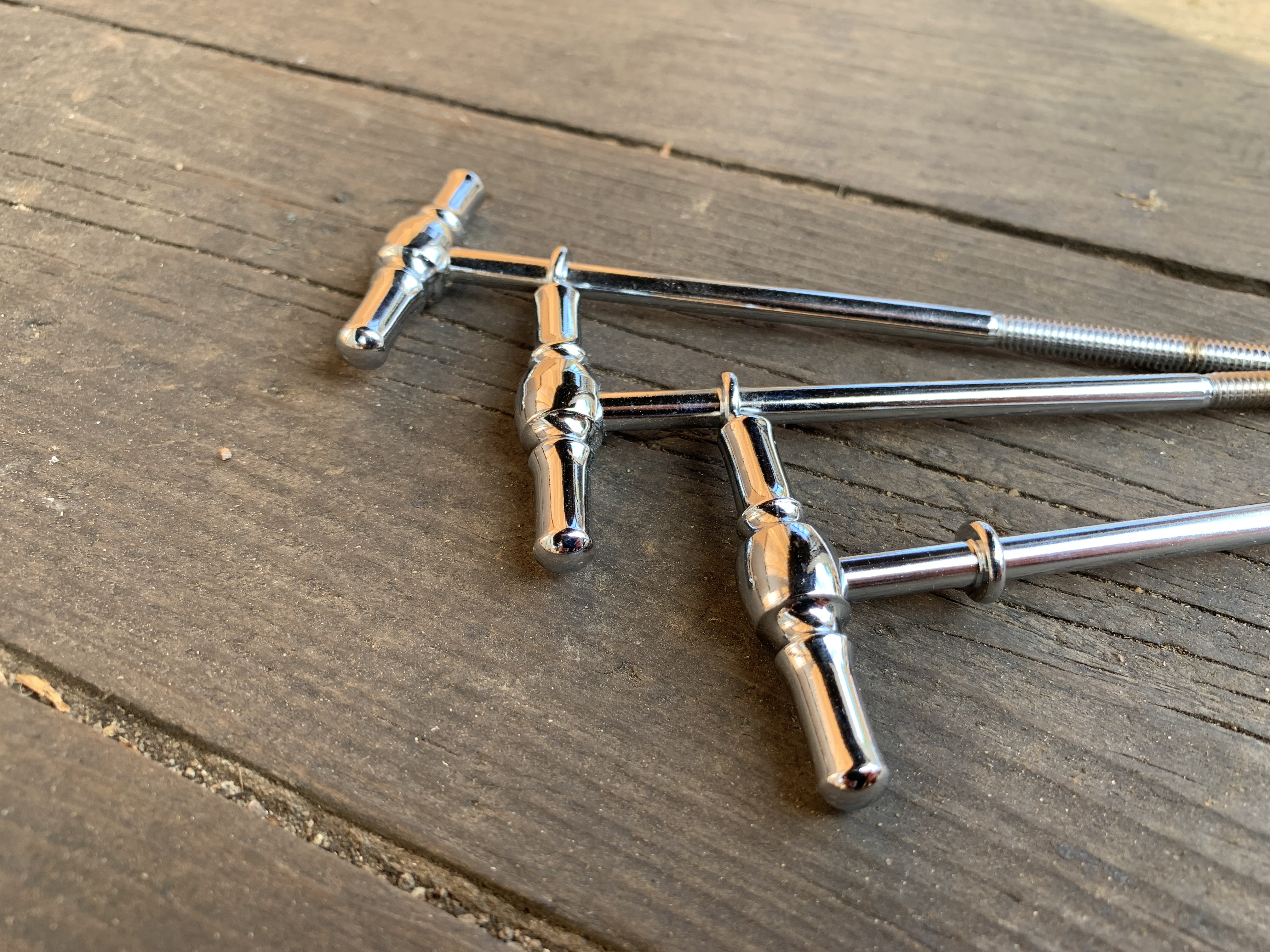
I glued a strip of white marine pearl wrap (STDrums) I had from previous projects. Because I was going to fit the drum with natural heads, I susbstituted the original square-headed tension rods with tap-style ones. Changes in temperature and humidity greatly affect natural heads, so you have to constantly adjust the tunning of the bass drum. Tap-style rods are much more practical. I got these "Paris style" tension rods at STDrums: 
 

© David Valdés


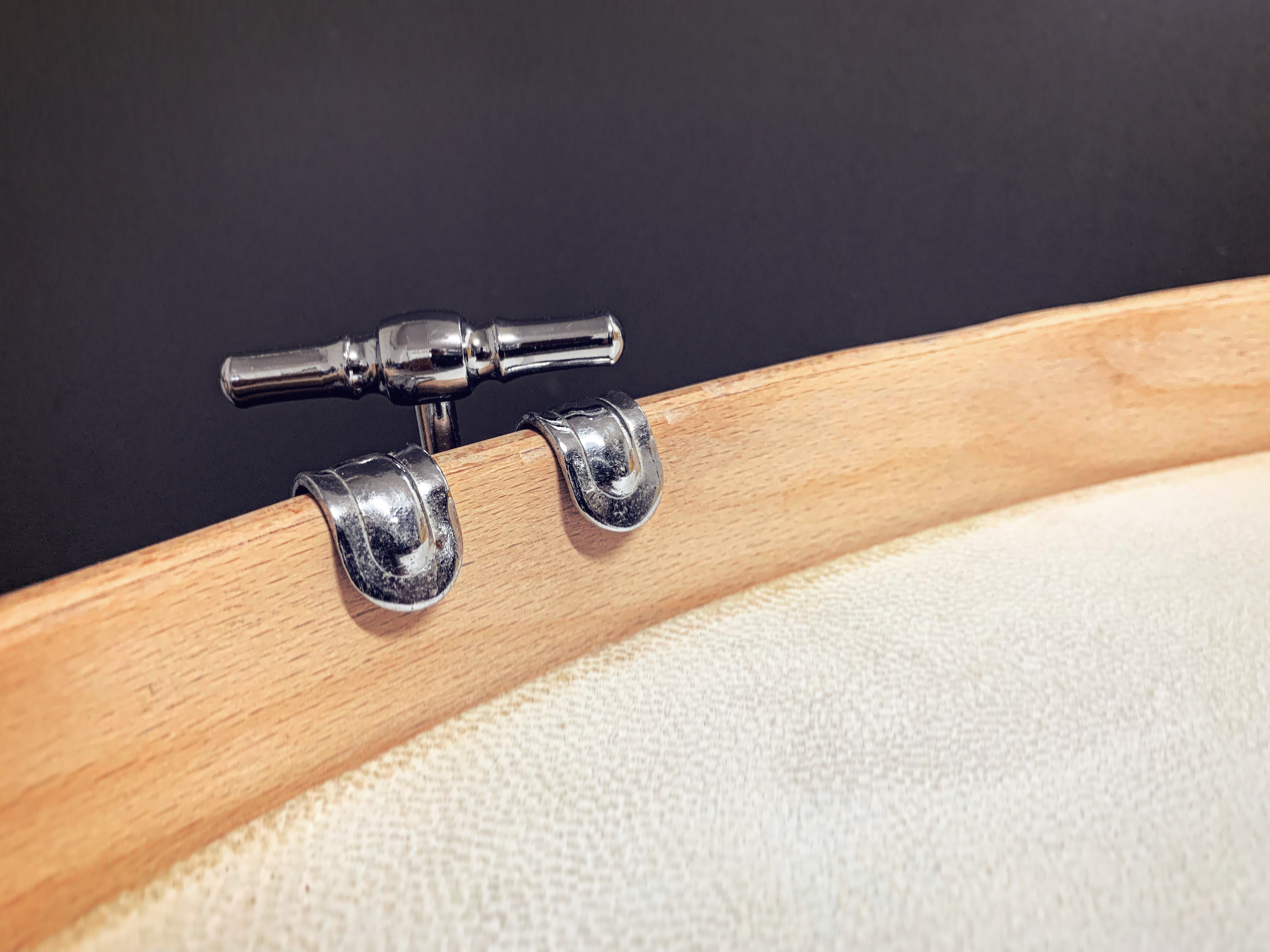
Here you can see the original claws and the new tension rods on the counterhoop:
 

© David Valdés


With everything ready, I only had to put the goat skins on (Baena Sonido) and mount everything. Here you have some photos:


© David Valdés

© David Valdés

© David Valdés


This bass drum features the measures, character and look I was looking for for my project; on top of that, it sounds fantastically well! Also, apart from being a perfect chamber-music-bass-drum, it can also be incorporated into a trap set (remember this article on Milhaud´s concerto), so it is doubly useful.

A future article will show the different mounting possibilities of this bass drum. Stay tuned, as this has just began 😉.


…et in Arcadia ego.
© David Valdés

Tuesday, 12 April 2016

Muffling the bass drum in style.

Tried and true instruments/heads combinations exit... Oversized Ludwig Professionals (32", 32", 29" and 26") with REMO heads is a classic, as the Supraphonic/Emperor, Hardtke/Super Kalfo...
 
The more I play the bass drum, the more I realize this instrument doesn´t sound at its best when mounting plastic heads: they produce funny harmonics, resonate excessively, you can hear the sound of the material instead of that of the instrument, tone is always improvable... Calf heads make the bass drum sound good doing almost nothig but, in exchange, they present their own problems (changes in temperature, humidity...). I do accept these challenges because of the far superior sound these heads produce. So, to me, the tried and true combination when it comes to bass drum is that involving calf heads.
 
When plastic heads are the tool at our disposal, the usual thing is muffling the head using a hanging towel secured to the counterhoop with a clip. Playing with the amount of material lying on the head, we can control resonance and harmonics.
 
 
© David Valdés


On this photo you can see a towel hanging as previously described (the ones I use are from IKEA, dirty cheap and discreet on stage due to the black colour). Don´t mind about the length showed, as it´s just a "pose": I just clipped it for the sake of the photo. 

Last time I used this trick I had a problem: when playing, the free end of the towel moved up and down, shaked by the head, hitting it, acting as a snare and producing a very annoying buzz. Maybe the audience could not hear it, but it was driving me mad...

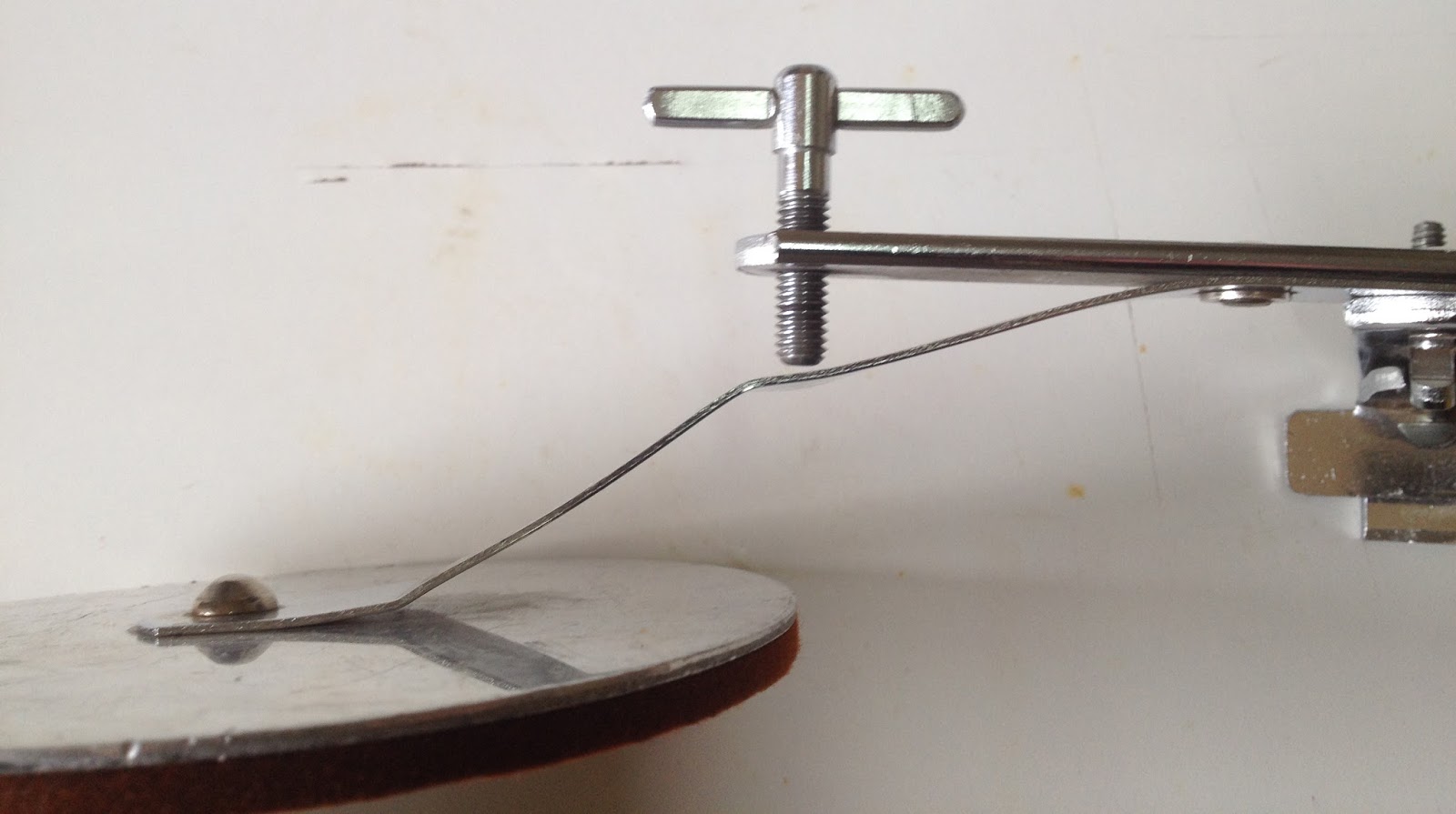
When thinking about solutions trying to solve the problem, get the instrument under control and get the best possible sound, I remembered a device used on vintage drum sets. It is a felt pad attached to a round plate with articulated arms which you can fix to the counterhoop. Using wingnuts you can control the pressure it exerts on the head and where on it (by bending the arm). You could see it mainly on bass drums, as the other drums on the kit used to have it inside.


© late8


I got one a few months ago. My intention was to not necessarily use it on a kit, but I knew that, at some point, it would come very handy for whatever weird purpose my mind would come up with. This is the one. It has no brand or inscription on it. Maybe a Ludwig? It´s 15cm in diametre and its arm is 25cm long. As with everything, you can go the expensive way if you get a vintage, fancy one, but you can get a modern one for a very fair price (STAGG).


© David Valdés


© David Valdés


© David Valdés


© David Valdés


© David Valdés


Here it is on the head, ready for some action.


© David Valdés


The muffler moves together with the head, you can press it more or less against it, there´s no play between them, you can move it closer or away from the counterhoop and it produces no buzz at all. It works flawlessly. Just one thing: its size is intended for bass drums no larger than 24", 26". As symphonic bassses can reach up to 40" in diametre, its surface may be not enough to get the desired effect on instruments this size. I would have loved some more control, but this device can be very easily modified to get more contact surface. Even that, I got rid of the buzz and the bass drum sounded very well.

A calf head is the best option for a bass drum (I think, in fact, it´s the only option) but, if not, the towell trick has proved (quite) its effectiveness. If the towell is giving you a hard time, this muffler is a fantastic solution to play your bass drum not only with control, but with some style...


…et in Arcadia ego.
© David Valdés

Sunday, 26 May 2013

A king size bass drum.

After a looooooooooong time without writing (will explain why in a future article), I´m back to the office, retaking Percusize Me!, and willing to update it with the frequency I used to.

On May 17th and 18th, I played Verdi´s "Requiem" with the Ulster Orchestra. JoAnn Falletta was on the podium, and the choir was the union of the Belfast Philharmonic Choir and Codetta. Concerts took place at the Belfast Waterfront Hall and the Derry-Londonderry Millennium Forum.

I´m sure you all know the importance the bass drum part has in this piece... Well, my colleague Sam Staunton, in charge of playing it, hired the services of the "little boy" you can see here:

© David Valdés

This bass drum was built by Empire Drums, legendary percussion company located in London. It closed down several years ago, and much of its material was purchased by Bell Percussion (in fact, I remember eBay auctions selling huge amounts of instuments when the company went out of business). This bass drum is now part of Bell´s backline, and it can be rented. You can see it HERE.

It measures nothing more and nothing less than 66" in diameter (around 1.70 meters). Taking into account that a 40" (1 meter) drum is considered "big", you can get an idea of the size of this instrument...

I couldn´t measure its depth (I normally don´t carry an imperial measuring tape arround...), but it´s fairly shallow. You can see it in the next photo.

© David Valdés

In this other picture, I have used a Tom Gauger TG04 mallet as a reference. The stick is 15 3/4", so the depth of this drum is roughly 16". We shouldn´t be surprised by the shallowness compared to its diameter, as this is quite common with British bass drums ("gong drums" are quite popular in this country: fairly considerable diameter, shallow, single headed... Many orchestras still use this design nowadays, the London Symphony among others). 

© David Valdés

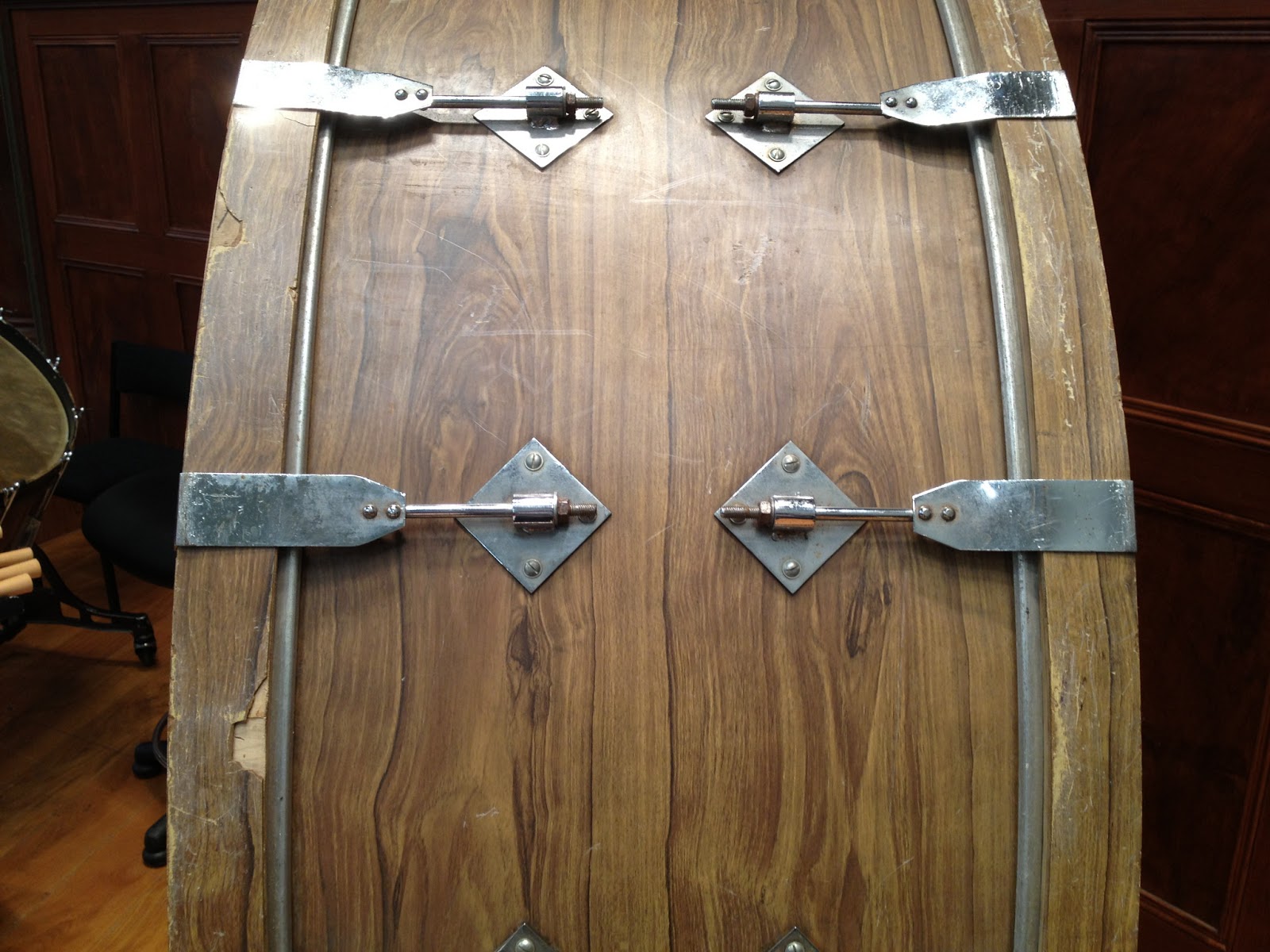
In the two following photos you can see the claws, tension rods and lugs controlling the counter-hoop. It´s pretty obvious they are not very practical, as you cannot access them from the front, and you need a key in order to manipulate them. You better like the sound Bell provides the drum with, as trying to change it is a pain in the ass.

© David Valdés
© David Valdés

With regard to the size of the head, well... you can get an idea! There´s no cow in the world with enough skin so as to make a natural head for this drum (we would need a diplodocus!). The head is synthetic, and was made on purpose by Remo. Even this maker had problems making a head this big... In the two following photos you can see a line crossing the head: that´s the point where two sheets of material were joined, as not even their biggest sheet was enough to cover such a big surface.

© David Valdés

© David Valdés

Now, compare the size of the stamps you can have on your Remo heads on your snare drums with the one on this... It´s almost the size of my hand!

© David Valdés

The cradle is very solid (and heavy!), and the bars sustaining the drum are covered with cork.

© David Valdés
© David Valdés
© David Valdés

It features two vent holes in two diametrically opposed points on the shell (next to the stickers advertising its new owners).


© David Valdés

It also features a plaque honouring the builders of this instrument, but it´s a shame it doesn´t mention a date. Will try to get in touch with Bell and investigate the age of this bass drum.

© David Valdés

Despite I used an oversized set of timpani (32", 32", 29" and 26", which is far for negligible in terms of size), they paled size-wise with respect to the "monster" I had next to me.

After that much information, the only thing left is to see it in action. This video was recorded during the first rehearsal by Phil O´Kane. The sound is not great, as a a domestic camera was used, but you can get a rough idea (although the ideal thing would be to feel its lows in person...).


By the way... Have you realized Sam, even when playing the tutta forza strokes, remains seated? This may remind you the "To sit, or not to sit? That is the question" article.   


…et in Arcadia ego.
© David Valdés