Wednesday, 10 April 2019

Do It Yourself Turkish crescent.

You already know how much I like historical percussion and early music. I have been wanting a Turkish crescent for quite a long time, so I bought some stuff and decided to go for it. Before going on, I´d like to introduce you to the instrument: a Turkish crescent ("jingle Johnny", "chapeau chinois", "pavillon chinois", "schellenbaum", "cevgen", "capell cinese", "padiglione cinese", "mezza luna"...) is an instrument many centuries old, but Europeans got to know it in the 16th century because of the Turkish elite troops, the jannisaries. It was inmensely popular as a military instrument (both in bands and orchestras) untill the 19th century, falling into oblivion since then. Lully, Haydn, Beethoven and Berlioz were some of the composers who wrote for it, and it was an important member of the sistri, being part of the bassa musica in the Italian opera from the ottocento.


"Gabinetto armonico" (Filippo Bonanni)


Here we can see a manuscript note stating the percussionists in the percussion section of La Scala during the 1843 spring season. We can see the Turkish crescent was part of the section (it ALWAYS was, and it was ALWAYS played together with the bass drum and the cymbals. The parts were never written, but it went without saying -see Lichtenthal, Picchianti, Dacci and others-). We can also see two different players are assigned for the bass drum and the cymbals, which busts the myth of both instruments being played "alla turca" (by one player) in Italian opera (we also have poster bills, hand bills, payrolls, documents, iconography and letters proving this). As a curiosity, because the date (1843) and the mention of a drummer, we can deduce "Nabucco" was still being played (it was premiered in 1842). "Nota dei professori d´orchestra al servizio dell I. R. Teatro La Scala per la stagione di primavera dell´anno 1843. Timpani: Carlo Antonio Boracchi, tamburo: Augusto Stehle, triángolo: Leonardo Negri, capell-chinese: Antonio Sala, piatti: AntonioTangi, gran cassa: Gaetano Rossi".


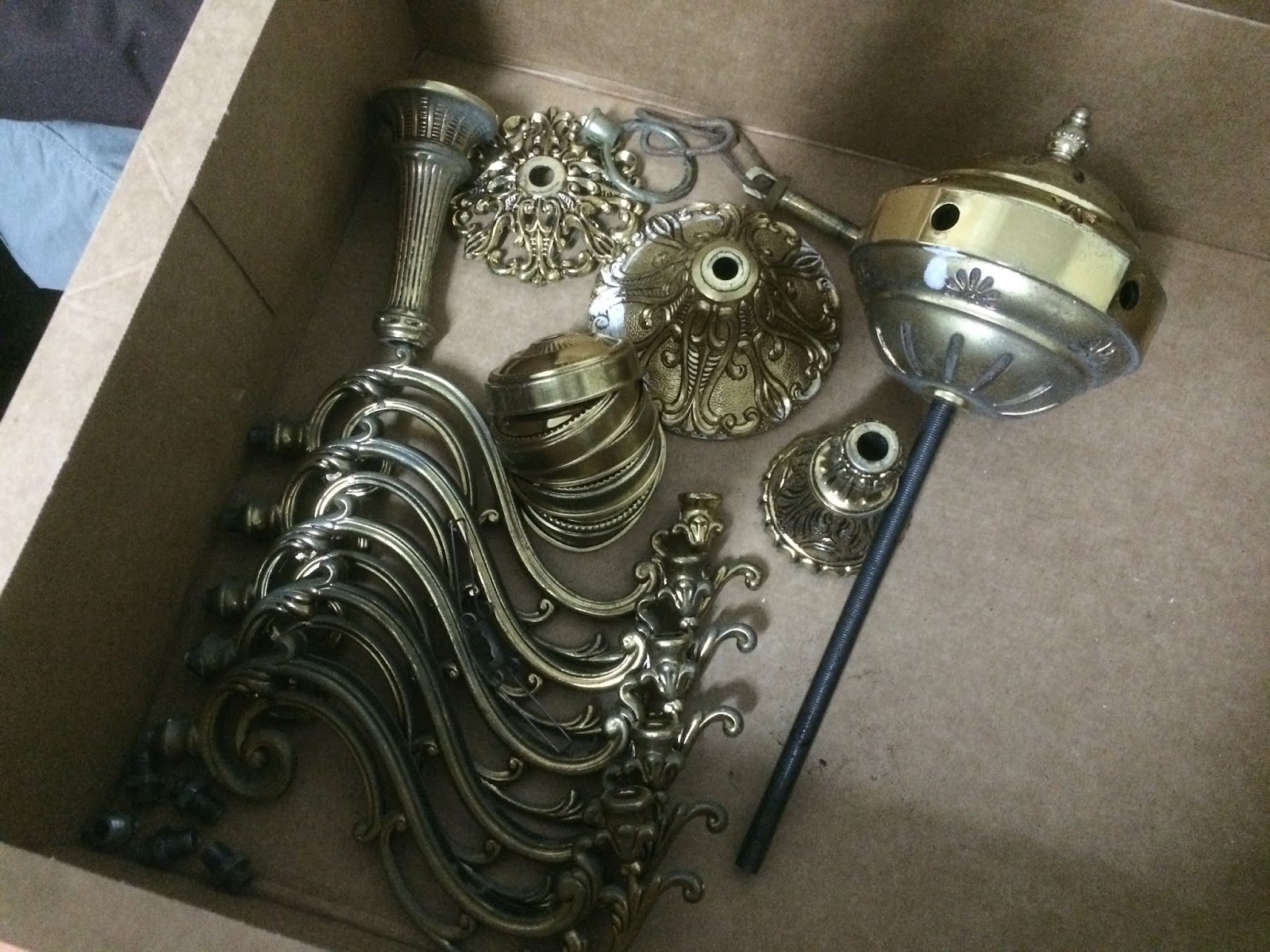
My project started with a visit to the local flea market, where I bought a horrendous old lamp. Ugly as hell, but perfect for the idea I had in mind...


© David Valdés


I dismateled it down to pieces, took the cables off, cleaned it...


© David Valdés


The "wings" of my crescent would be the lamp arms, which I attached to the "vases" holding the bulbs. I first marked two diametrically oposed points...


© David Valdés


...and then drilled, first marking with a punch so the bit doesn´t slip. Then I used progresively larger bits untill I got to the desired diametre.


© David Valdés


© David Valdés


Then it was just a matter of screwing the "wings" using the same nuts the lamp already had.


© David Valdés


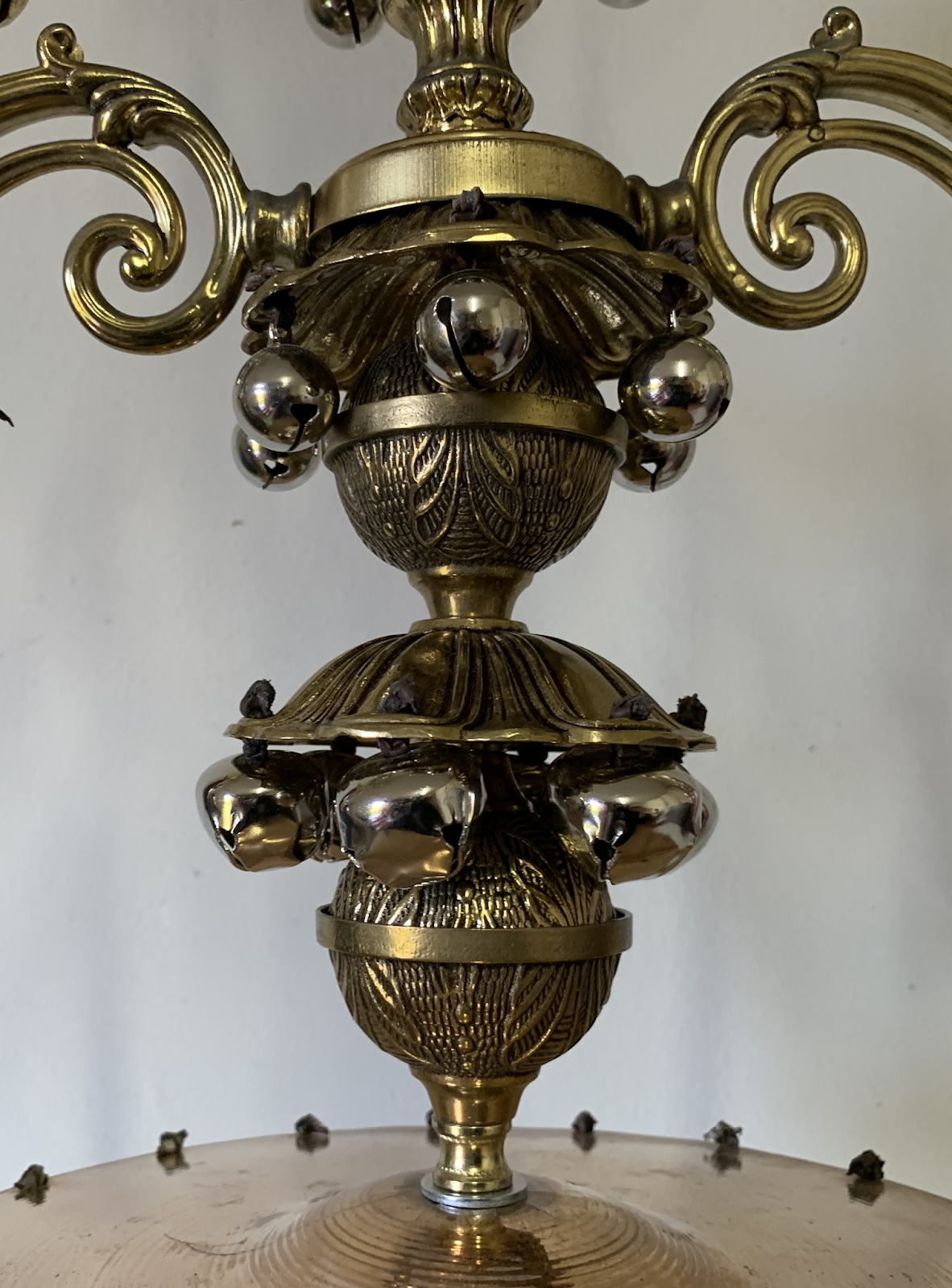
With the "wings" done, all pieces ready, and using the central rod the lamp already had, I started skewering and combining the different pieces. I also hang sleigh bells from the different "umbrellas". As always, I punched before drilling, and then used progresive sizes of bits. I attached the sleigh bells using leather straps.


© David Valdés


Looking for inspiration I found this crescent. I liked the bottom part very much, so I tried something similar:


How to do it? I had some cymbals laying around. I collected then when I was trying to learn how to weld bronze. One of them was a 10" Sabian Pro Sonix, the only blemish being some cracks around the hole. Perfect for the job! Using an angle mat I marked 20 points:


© David Valdés


I marked and drilled as usual, got rid of the logos to make it look more "authentic" and "historical" and hang the bells around its perimetre using leather straps:


© David Valdés


© David Valdés


© David Valdés


© David Valdés


This is how it looks on the instrument:


© David Valdés


As you can see, the central rod is visible, as I ran out of lamp parts to cover it, so I paid another visit to the flea market to get another batch of horrendous lamps...


© David Valdés


Here´s how it ended up. You can also see how I finished off the whole thing at the end (using one of the remaining "cups"):


© David Valdés


© David Valdés


I added sleigh bells to the new "umbrellas":


© David Valdés


I also covered the holes the "dome" still had. I got some extra volutes at a scrap yard (which I visited to get raw material for a project I´ll write about in the future 😉). I used a file to shape the arms to the round surface of the "dome", and fixed them using screws:


© David Valdés


I added some more bells, and this is the final result on the "dome":


© David Valdés


As a final detail, I added the horse hair traditionally present on these instruments.


I bought some red tassels at a local haberdashery and hang them from the lower arm:


© David Valdés


Now, a pole was needed to hold the whole thing, so I got a bronze finished curtain pole at Leroy Merlin.


© David Valdés


I also got some door stoppers, which I lightly sanded, to help me put everything together.


© David Valdés


© David Valdés


Now I just had to stuff the "Christmas tree" into the pole:


© David Valdés

Because this instrument is sometimes played hitting the floor, I kept the rubber feet the pole already had.


© David Valdés


I also made some pads using yoga mats should maestri don´t want the stompig noise against the floor.


© David Valdés

I was able to make an instrument which was inmensely popular for some centuries and was abandoned when orchestras increased in size, bass drums and cymbals became larger and larger and their volume covered the sound of the Turkish crescent, making it useless. Nowadays, this instrument is a must if you are into historically informed performance. Would you add it to your section? 😉 Stay tuned, as I will soon upload some video files.


…et in Arcadia ego.
© David Valdés

Thursday, 14 March 2019

"Castagnettes de fer" in Saint-Saëns´ "Samson and Delilah".

"Samson and Delilah", by Camille Saint-Saëns, is an opera premiered in 1877 containing some interesting percussion parts. So, the glockenspiel in the 3º scene of the 3º act is a usual suspect in audition lists, the timpani part in the "Bacchanale" is a good one (and also an occasional visitor to lists), the triangle in the finale, altough not particularly difficult, is fun to play... But, if we have to point the one that has attracted the most attention to itself, that´s the "castagnettes de fer" part in the "Bacchanale".  This article will deal with it (you can download the part free and legally HERE).


In this bacchanale, which connects with the French tradition of adding dances to operas and happens right before the dramatic ending in which Samson demolishes the temple by pushing two columns, wooden and metal castanets are asked for ("de bois et de fer"). No problem at all with wooden ones, as that´s what percussionists have been using for centuries (millennia!), but metal ones have been causing trouble since the very moment this opera was premiered, as this is not a traditional instrument nor it is asked for in any other work of the repertoire (none at all!).

I have seen finger cymbals being used (which makes total sense, as those would be the instruments used by dancers in the Middle East during biblical times):   


©Amazon


In fact, in Filippo Bonanni´s "Gabinetto Armonico" (Roma, 1722) there´s a specific mention to naccare being played by bacchants ("a woman taking part in bacchanales"): "She [the bacchant] is holding a couple of little metal bowls in both hands, which they are struck one against the other, and with their beating pagans gathered in dances honouring the gods". I can´t think of a better description of what´s going on in the opera at that precise point... 😉
  

"Gabinetto Armonico" (F. Bonanni, 1722)


I have also seen Moroccan qraqebs, qaraqebs or qarkabas being used:


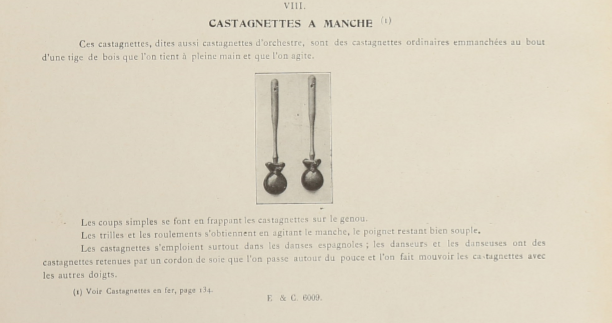
I find any of these two options perfectly fine for playing the part (specially the first one). But... Should we decide to stay true to what Saint-Saëns asked for, want to use the original instrument and be historically correct, none of them is the one... The answer to the mistery is in a book entitled "Méthode de timbales et Instruments à Percussion", by Joseph Baggers.


Baggers was born in Antwerp in 1858 and died in París in 1938. He was timpanist for the Théâtre National de l´Opéra-Comique and for the Société des Concerts du Conservatoire, and also taught at the Conservatoire National de Musique et Déclamation (he was the percussion teacher of a very young Olivier Messiaen). 


Baggers knew his stuff because, when "Samson and Delilah" was, at last, performed at the Opéra National (it was premiered in Germany fifteen years before, as the biblical plot was considered not of the interest of the Frech audience), Saint-Saëns himself supervised the production, which was conduct by Édouard Colonne, one of the "stars" that, at the beginning of the book, praise the good job done by the author. In addition, Colonne addresses Baggers with affection and familiarity, which indicates they knew each other. Have you read "Monsieur Crochet antidiletant" (C. Debussy)? If yes, Colonne and his concerts may sound familiar to you. Even more, Debussy is also one of the authors prasing  Baggers´ job at the beginning or the book. I don´t know whether Baggers played or not on that particular occasion but, it is quite clear that, at least, he had first hand information from Colonne.


So, on page 134 we can find the following:


"IRON CASTANETS. 
This little used instrument (Saint-Saëns, Samson and Delilah), is played like the normal castanets".

Well, we have a problem here... This instrument can´t be played like "normal" castanets because "normal" castanets are not connected together by a "U" shaped handle. So here we have what´s a normal thing in the orchestral world: a trick, a machine, a way to play castanets (whether they are made of wood or iron) which facilitates playing them without having to use their consubstantial technique.

Here you have it... On page 122 we can find what Baggers considers "normal" castanets:


On the last paragraph he mentions what I do consider "normal" castanets: those played hanging from the thumbs. Baggers states that that´s how dancers play them, but he names "orchestral castanets" (therefore the kind he would have used) those with a handle. Pretty obvious that, if his wooden castanets were furnished with handles, so his metal ones (as we have already seen).

So? With the solution by those percussionst unaware of the proper traditional technique, one saves time acquiring it (but that´s a personal "war" of mine, forget about my insistence on this particular topic 😉).

Now, go back to the photo where Baggers proudly poses with all those instruments... That makes me think that arsenal is his personal collection (or, maybe, they belonged to the orchestra which, at the time of the book being printed, he was playing for. I´m up for the first option). Right opposite the timps we can see a pair of wooden castanets (those to the left of the spectator, as we can see the central clapper against which the two shells would have hit) and the metal ones (those to the right, as there´s nothing in between them, both hitting directly against each other).


I can´t positively confirm whether Baggers played "Samson and Delilah" or not on that particular occasion, but one thing´s for sure: he and Saint-Saëns had common friends and colleagues, and Baggers mentions the xylophone and "Danse Macabre" (the xylo appears in the group photo and is described on page 133), so chances are they knew each other and worked together. It is something quite common: a composer approaches a specialist asking for advise, and said specialist goes: "follow this path, don´t follow that one, that´s easy, that´s hard, write this, write that, use this instrument, don´t use that one...".

Im guessing... Probably, Saint-Saëns saw some of Baggers´ instruments and decided to include them in his scores. Maybe it was the other way round: Baggers saw what Saint-Saëns wanted and approached him saying "why don´t you use this cool thing I have here?" Very often, composers write with the orchestra (thus its instruments) which is going to play/premier a work in mind. This, when using uncommon instruments, is a problem when different orchestras play that same work, as they may not have the instrument or may be unconnected to a particular tradition (remember that´s the case with Bartok´s "Bluebeard").

We must remember that Wagner had already scored for castanets in the Bacchanale of "Tannhäuser". "Samson and Delilah" was premiered in Germany, so the castanet requirement by Saint-Saëns wouldn´t have been strange to German percussionists (as a curiosity, both parts share the one 8th-two 16ths rhythmical pattern. Did Saint-Saëns castanet writting find inspiration in Wagner´s?). Maybe, when "Samson" was played at the Opéra National, Baggers approached the composer and told him "see what a cool toy I have here... Why don´t you add it to the apart the Germans have already played?" Or, maybe, Camille saw Baggers´collection, approached him and said "you have a nice toy there... I may use it, it may be cool". And that is something I would really love to know: was there a castanet part (wooden) used in Germany at the premiere and another different one (wooden plus iron) used at the Opéra National because of Baggers´ influence? Musicologists, you have an assignment here... 😉

My humble opinion is that, when it comes to authenticity, historical and musicological exactitude, the best option to describe the musical context in the Middle East during biblical times would be the finger cymbals one (the one refering to bacchants), as it fits perfectly. But, whether we like it or not, should we want to be true to the original part Saint-Saëns himself supervised at the Opéra National, we must use the instrument described on page 134 of Baggers´ book. Good news is there´s an instrument maker in the UK (Matt Nolan) who, based on the photos in the book, makes a perfect replica of this instrument:


© Matt Nolan


Surprisingly enough, Rafael Casanova (principal percussion, OSPA, and my former teacher) got to a very similar and clever solution using ice tongs with a couple of finger cymbals attached to both ends. That´s how we played the part when Ópera de Oviedo staged "Samson and Delilah" in the 2015 season.
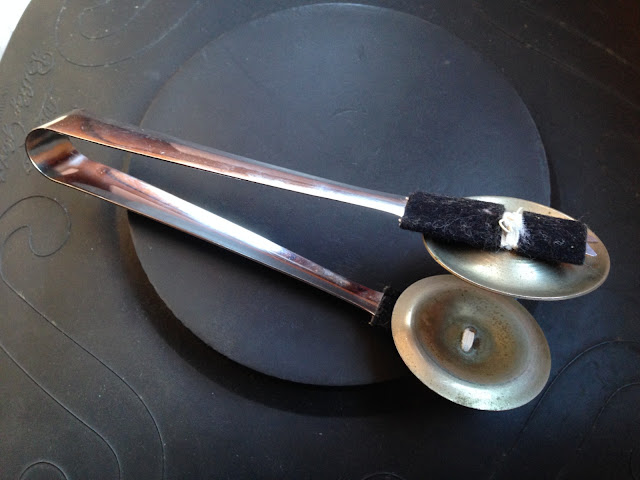

© Rafael Casanova


You now know the mess you will get into should you have to play this opera 😉. I´d love to know what´s your solution for the "castagnettes de fer". Tell me!

This article is dedicated to David Vatteville for his kindness and generosity. 


…et in Arcadia ego.
© David Valdés

Friday, 18 January 2019

A curiosity: on the anatomical and physical condition recquired to play a drum.

As you already may know, I have a keen interest in everything related to the history and tradition of drums. Searching for information in the Biblioteca Virtual del Ministerio de Defensa ("Virtual Library of the Ministry of Defense"), I found a book entitled "Manual para las bandas de cornetas y tambores" ("Manual for the cornets and drums bands"), written by Manuel Novoa López in 1901 (you can download it legaly and free of charge by clicking on the link).


Having a quick look at it I found something that caught my eye, and today´s short article will deal with it:

One of the most common things one can read in groups, forums and other drummers sabbaths is that wrists "have to be strengthened", that "they need to be developed", that "you need strong muscles", "strength is need in your wrists" and things like that. You can easily find percussionists who advocate this, together with exercises and calisthenics to transform your wrists into killing devices capable of bending steel beams...

This has always surprised me... First, because I have never considered technique as sheer brute force. On the contrary, I think it´s a matter of hability, dexterity, logic and reasoning. Second, because my wrists are more like those belonging to a delicate Versallian damsel than like those hairy wrists belonging to a Rhine bargeman. Well... This is what today´s article is all about: a curiosity in this book which recommends quite the contrary to what we are used to.


"ON THE LEARNERS OF THE DRUM

They must also observe the rules prefixed in paragraphs 1 and 2 regarding the learners of cornets, and to have the wrists thin and agility in the arms, in order to be able to handle the sticks with ease.

For this reason, I order that if they can be boys of the civilian class, they are preferable to the soldiers of the companies, for the latter have their wrist too developed, being that a great setback for learning the drums.

Meeting all these conditions both the cornets and drums, it is most likely to get satisfactory results in a short time".

Funny, isn´t it? According to the author, the drummers, who are going to beat for extended periods of time at great volume in the battlefield, don´t need (more on the contrary!) specially developed or strong wrists.

There´s another remarkable thing in those three paragrahps: the author mentions "boys", and that connects with the drummer boy tradition. There was a time when infantry drummers were teens, even children (records exist proving that nine and ten years old boys served in the American Civil War). Because of the year this book was written (1901), it seems very unlikely that children were enroled, but it´s plausible that boys in their 15s, 16s or 17s were admitted in those bands. 

Let´s leave the drummer boy thing for a future article. Today, the interesting thing is what was, at the beginning of the XXth century, considered appropriate, in terms of anatomics and physical condition, to play a drum.   

So... How are your wrists doing? 😏


…et in Arcadia ego.
© David Valdés

Thursday, 10 January 2019

The New Year´s concert, the "Österreichische locke" and tradition on snare drum.

With the New Year´s Concert still fresh, today I´d like to write about something we all like: the snare drum "solo" preceding the traditional "Radetzky March".


Here you have the snare drum part. Apart from some missprints here and there which can be easily corrected on the go, there´s nothing on it indicating an introduction:


Where do those eight bars come from? The answer is easy and obvious should you have ever played in a wind band. From time to time, and in order to allow wind players to rest, there are moments during a parade where the band stops playing music. During that "resting time" in which musicians are not playing, they still march and mark time and, for them to do it rhythmically, there´s one musician that doesn´t stop playing: the drummer. The drummer plays a marching beat (which one depends on the country, tradition, type of music, personal taste...) and, when the drum major wants the music to start, he "signals the drummer, the drummer rolls off and the band picks it up without any loss of time".

Well, the "solo" we hear right before the Radetzky March is a roll off indicating the rest of the band that they have to start playing at the end of the eight bar phrase. That "call" also dictates, quite obviously, the tempo. Is that "call" something played at random? No... We can´t forget the Radetzky March is military music written in an country with great musical and martial tradition, belonging (at that time) to the Austro-Hungarian Empire, very proud of its traditions. Every infantry and cavalry has its own beats and signals, so each one of them has their own roll offs.

These eight bars played before the Radetzky March form the "Österreichische Locke" ("Austrian Roll Off"), which every Austrian musician knows, as it´s part of their tradition and musical heritage.


As you can see, it´s a phrase intimately related to the Austrian military and musical tradition. There´s no need to write it down, as every drummer knows it. If we want all the musicians in the orchestra to start playing without a cue from the conductor, all they need is that eight bar phrase.


Do more roll offs exist? Of course... There´s also the "Deutsche Locke" ("German Roll Off"), in use in this country and in 6/8 (also a typical marching bar):


These roll offs are not only played in Europe. In quite a few South American countries (Chile, Paraguay, Perú...) this "calls" are played due to the Prussian influence, as Prussian officers were in charge of putting together, organizing, arranging and training the new armies of the new countries after their independence from Spain.

There are also roll offs in the United States...


Are those drums, bass drum and cymbals at the beginning coming from Alfred Newman´s inventiveness? No... That introduction proves he knew well the military tradition, as he is literally quoting a roll off. I found this roll off in page 57 of  Sanford Moeller´s "The Moeller Book: The Art of Snare Drumming". The book was published in 1925 (quoting music dating back many decades -centuries!- ago), the fanfare was composed in 1933. See how internalized we have military, popular, sacred music...? Much more than we think. 


Before fininshing, I´d like to show you the version of the Radetzky March that, under Óliver Díaz, the Gijón Symphony Orchestra recorded live during the 2005 New Year´s Concert. Truly yours on snare drum:


Now you know your stuff... Next time a conductor asks you to play an introduction to "Radetzky March", you won´t be wrong with the "Österreichische Locke". That will be the most authentic and true to the original spirit.
 
Should you want to play in the true Viennese style, feel free to download my own edition of the percussion part (send me an email should you want a pdf version). Upload your videos, photos and tag me. I´ll be happy to know my version is played around the world. Here it is:


I´d like to thank Manolo Durán for his help and knwoledge.


…et in Arcadia ego.
© David Valdés

Thursday, 6 December 2018

Do It Yourself historical rope drum (III).

Today I´m bringing you the third part of my "Do It Yourself historical rope drum" project. You can check the first part HERE and the second one HERE.

This is how the drum looked like at the end of the second part:


©David Valdés


As I wanted to emulate historical designs, I had a very clear idea since the very beginning of this project: to decorate the shell with tacks, a normal procedure centuries ago (and a necessary one because, when bending the wood to form a cylinder, we get a join that needs to be reinforced for the shell to stay in shape. It was also a decorative element and, because of the different patterns, it was also used to identify makers). So, looking for inspiration, I searched in the iconography and surviving historical drums:


"The nightwatch" (Rembrandt)


"Boy with a drum" (Rembrandt)


American Civil War drum


American Civil War drum


 American Civil War drums belonging to William F. Ludwig II


British long drum (1714-1727). National Music Museum. Here you can see the seam where the shell overlaps over itself and how it is reinforced with tacks.


Bass drum by William Kilbourn (Albany, New York). 1864-1869. National Music Museum


Trying not to screw it up or irreversibly damaging the shell, I did some preliminary tests on a board:


©David Valdés


Once I was confident enough, I got a compass and gridded paper, where I draw several concentric circumferences (using the vent hole as the centre). I then marked their perimeters with equidistant points. Those points would be where I would hammer the tacks. Once I finished the template, I fixed it on the shell with masking tape (so as not to damage the finish), centering it on the vent hole and aligning the "north/south" diametral line with the seam of the outer layer of the shell, which is also the symmetric axis for the snare bed and the vent hole. This way, all the elements would be centered and symmetrical (even the snare strainer).


©David Valdés


I got some nice brass tacks to harmonize with the rest of the elements of the drum but, before starting with the hammering, I had to cut them, as they were longer than the thickness of the shell (and I didn´t want them to go through it). As I always do, once cut I hammered their tips so they don´t crack the wood.


©David Valdés


Using the template, the next job (very boring, by the way...) was marking the points were I would hammer the tacks.


©David Valdés


Once done, I removed the template, revealing the marks. With this preparatory job done, hammering the tacks was a piece of cake.


©David Valdés


So, there goes the first circumference (12 tacks):


©David Valdés


The second one (24 more tacks):


©David Valdés


The third one (36 more):


©David Valdés


And, finally, the fourth one (48 more):


©David Valdés


Once I finished the central "rosette", I considered attaching a brass grommet to the vent hole, but checking the iconography I saw it wasn´t a feature present in historical drums, so I got rid of it.

©David Valdés


I completed the design (using the template and technique already described) with four more "rosettes", this time using different tack sizes to make them look like flowers.


©David Valdés


And here we have, 172 tacks later, the whole thing finished:


©David Valdés


The next thing I did was attaching a snare strainer (an 18th century replica I got at Cooperman which I gold plated to match the other elements -the original piece was chromed-):


©David Valdés


Using my angle mat, I marked a diametrical point to that of the strainer...


©David Valdés


...so I could attach the butt bolt (also by Copperman, and also gold plated).


©David Valdés

Here you have a photo of the shell, counterhoops and heads ready to get roped (bare in mind those aren´t the heads actually on the drum, as they feature aluminium flesh hoops, which are not historical. The drum does now feature goat heads mounted on wooden flesh hoops).


©David Valdés


I´ll show you the complete drum in a future article. Do you like this kind of finish?, do you consider it historical enough? 😉


…et in Arcadia ego.
© David Valdés

Wednesday, 17 October 2018

XIV Mislata International Percussion Festival

Next Saturday, October 20th, I´ll be involved in a masterclass invited by the XIV Mislata International Percussion Festival (Valencia-Spain). It will take place at Liceu de Música de Mislata between 10:00 and 14:00. I´ll talk about the new Spanish edition of "Método de Movimiento para Marimba", will deal with the technical aspects of the famous 590 exercises, will work on musical issues and will play and work repertoire with the students.

There will also be masterclasses by fantastic percussionists: Javier Eguillor on timpani, Noel Savón on Afro-Cuban percussion, Alejandro Galarza on teaching techniques, Aarón Cristófol on flamencode, David de Cubas on percussion coaching and Xaloé Marí on accesory percussion. There will also be concerts by Kolier Percusión and the Ensemble de Percusiones de la Universidad Autónoma de Nuevo León (Mexico). 

As you can see, it´s a very atractive festival, which I strongly reccomend. Here are some photos of the oficial brochure and a link should you want to get more information or get enroled: www.liceudemusicamislata.com.


Looking forward to see in you Mislata! 


…et in Arcadia ego.
© David Valdés