Showing posts with label Stravinsky. Show all posts

Saturday, 13 August 2022

Modification of a Premier bass drum (1)

This project is a consequence of a larger one; namely, to provide myself with the proper drums to recreate as close as possible the original sound, character and looks in I. Stravinsky´s "The Soldier´s Tale".

For the bass drum I used a 28"x12" Premier (model 188) from the 70s. Here you have a photo from the catalogue and a technical description:


© Premier Co.

© Premier Co.


It was finished in "Burgundy Pearl" and it featured "Everplay" heads:


© Premier Co.

© Premier Co.


Here you can see the bass drum when I used it in "Pagliacci" at the teatro Campoamor in Oviedo:


© David Valdés


This is the bass drum ready to be modified. As you can see, the finish was not specially beautiful.


© David Valdés

© David Valdés


The first thing I did was stripping off the shell, a task which was not very difficult, as the wrap was glued only in a narrow band.


© David Valdés


The next step was sanding the shell until it was perfectly smooth. Once done, I applied several layers of tung oil.


© David Valdés

These are the original lugs. Although I like very much their "Art Déco" style and I have already used identical lugs on some of my drums, it was not the look I was looking for (apart from the fact that they were not in perfect condition).


© David Valdés
 

In order to get a more antique and simple look I got some tubular lugs at STDrums:


© David Valdés

I also added some leather gaskets (STDrums) to avoid contact/friction noise. They look beautiful!!!


© David Valdés

Here you can see everything already mounted on the shell:

© David Valdés

© David Valdés


I then started working on the counterhoops. I got rid of the red wrap and the black paint (not from the central "channel" as it would get covered with the new wrap). I sanded them until they were perfectly smooth and, again, I applied several coats of tung oil. The next photo shows two different stages of the process:


© David Valdés


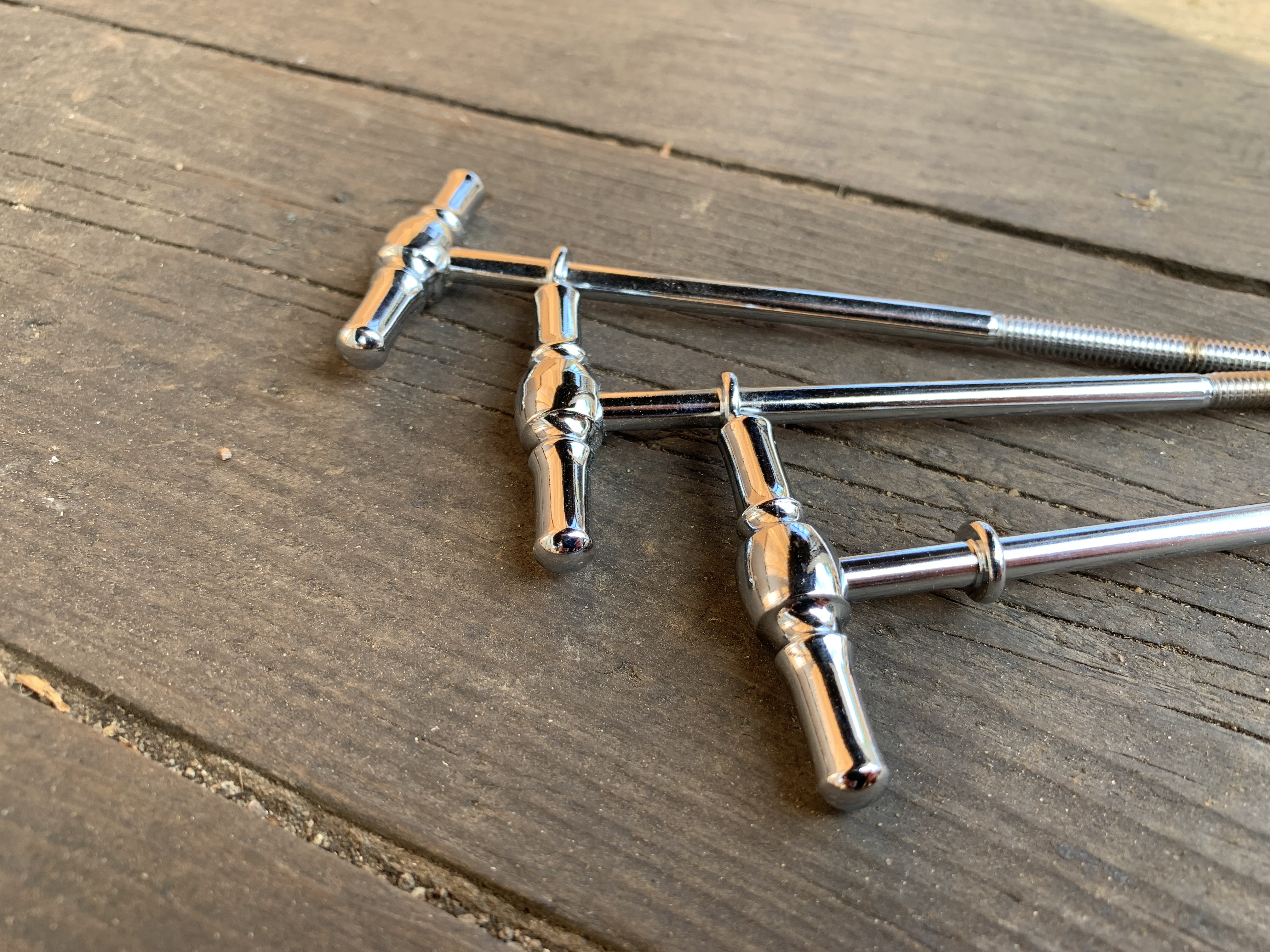
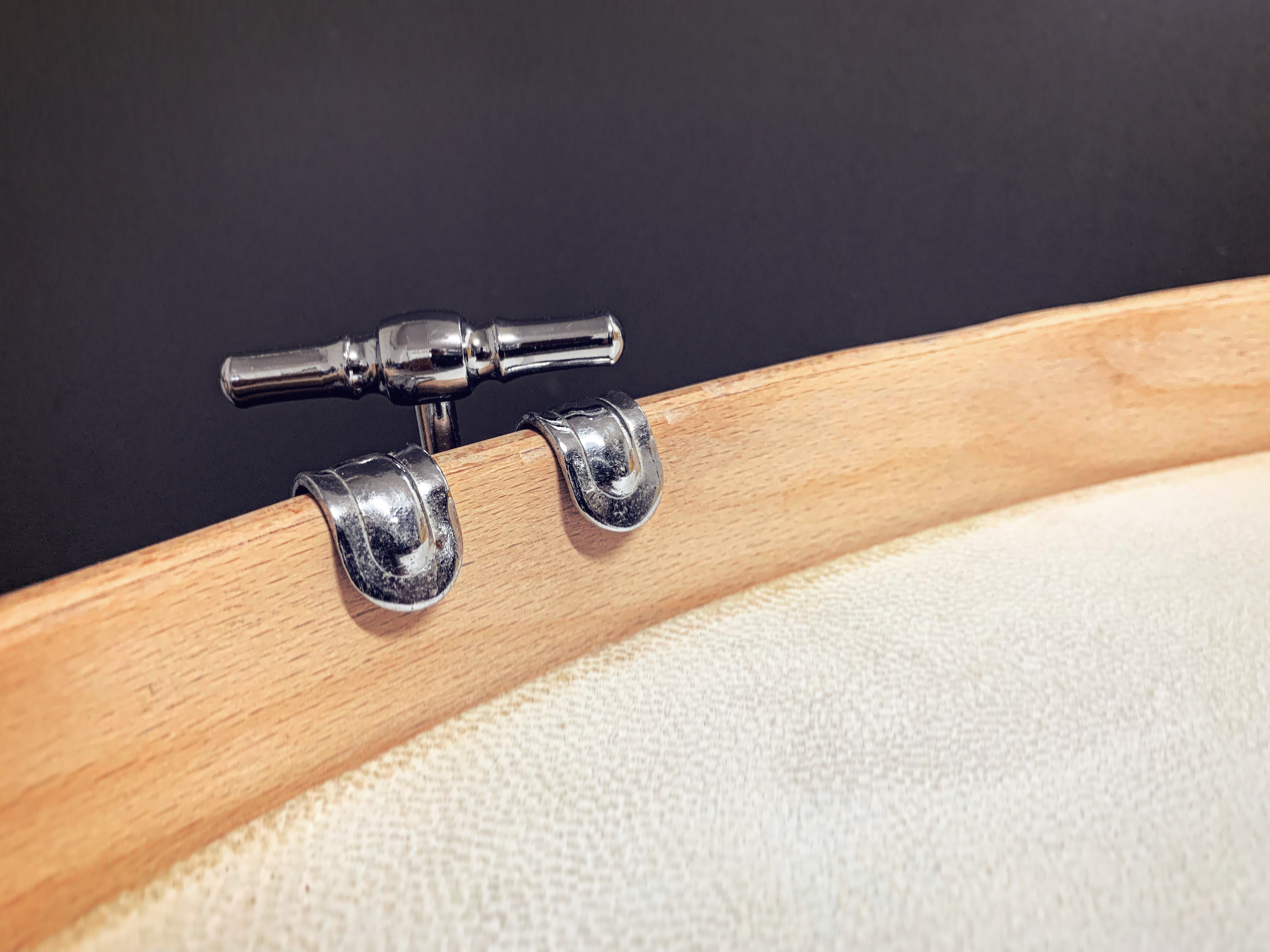
I glued a strip of white marine pearl wrap (STDrums) I had from previous projects. Because I was going to fit the drum with natural heads, I susbstituted the original square-headed tension rods with tap-style ones. Changes in temperature and humidity greatly affect natural heads, so you have to constantly adjust the tunning of the bass drum. Tap-style rods are much more practical. I got these "Paris style" tension rods at STDrums


© David Valdés


Here you can see the original claws and the new tension rods on the counterhoop:
 

© David Valdés


With everything ready, I only had to put the goat skins on (Baena Sonido) and mount everything. Here you have some photos:


© David Valdés

© David Valdés

© David Valdés


This bass drum features the measures, character and look I was looking for for my project; on top of that, it sounds fantastically well! Also, apart from being a perfect chamber-music-bass-drum, it can also be incorporated into a trap set (remember this article on Milhaud´s concerto), so it is doubly useful.

A future article will show the different mounting possibilities of this bass drum. Stay tuned, as this has just began 😉.


…et in Arcadia ego.
© David Valdés

Friday, 18 February 2011

Xylophone - Firebird.

Today we´ll speak about a real technical and musical challenge: the xylophone part for Igor Stravinsky´s "Firebird". More specifically, we´ll discuss the "Danse de la Suite de Kastchei Enchantée par l´Oiseau de Feu".


Here´s the music:


When we play this excerpt, we have to get on to the tempo of the orchestra at 126, and think 16th notes to perfectly fit in when we start playing. It´s a wise thing to listen to the 16th notes played by the strings so, eight bars later, when we start playing, we are already in tempo and 16ths are nailed.

The tempo indication is 152. Obviously, this will depend on the maestro, so we better practise faster and slower speeds so as not to get surprised by different tempi. On this video, I´ve chosen a tempo of 165. It´s a (let´s say it that way) audition tempo, maybe not to musical, but it´s a speed that proves a panel I can play fast and accurate; it´s a tempo that, when competing with other candidates, can tip the scales in your favor (or not... Who knows!).

My phrasing idea until the "storm" of 16ths starts (four bars before 130) is as follows: A little weight on the first note, get all notes from that initial energy, and taper down at the end:


I don´t know if that phrasing can be heard due to the compression applied by the camera, but that was my intention.

Equally important is the dynamic gradation: piano at the beginning, mezzo piano four bars later on , mezzo forte at 129, forte at 130, etc... Again, that was my intention, but I don´t think the compression makes it easy to hear wat I wanted to communicate.

It´s crucial that, during the rest bars, we keep feeling the 16th note pulse and look at the condutor. You may have realized that I raise my head to stablish visual contact with the hypothetical maestro: never ever get caught by a conductor not looking at him. When ever possible (this excerpt, because of its difficulty, it´s not prone to this), I always raise my head from the instrument to look at the conductor.

We have to be very careful with the rhythm played by the strings in 128, as they start the bar with an 8th rest, producing a syncopation. Don´t let that confuse you: our tempo and rhythm have to be rock solid. The same happens at 129, where the motif is taken by the double basses:


Four bars before 130, I change the logical sticking and I start with my left hand so as to play the fourth interval  between D and A with my strong hand (right one).


Until 130, our job has been a "colouring" one but, from that rehearsal number on, we are doubling either the woodwinds or the strings. We always have to be careful with our playing, but specially when doubling, as mistakes are more obvious due to some other instruments playing our same line.

At 131 and 132, where we are playing an upper pedal together with the strings, even we have a "generous" dynamic, I prefer to play a little bit less to let the other motif to be heard.

With respect to the ending (four bars before the allegro feroce), some players do an accelerando to prepare the new tempo, but I think it´s more effective and dramatic to make the change súbito (so it has a more ferocious character), but that doesn´t depend on me, but on the man with the batton. In an audition, I prefer to stick to the paper (and my own taste) and not play it. Different conductors involve different interpretations but, in an audition, I prefer to literally play what is writen so the panel doesn´t have to think, is he doing the accelerando because he knows the music, or because he cannot keep the tempo? When in doubt, I prefer to stick to the paper.

Last thing: you can see I play the last note with my right hand (contrary to the natural sequence). With that, I try to get the note that is supposed to be the strongest one with the recquired energy (I´m right handed).   

I urge you to listen to this fantastic piece of music. Do not miss the tremendous ending.


…et in Arcadia ego.
© David Valdés