Monday, 13 March 2017

Studio sessions: preparation and thousand more things.

On February 17th, 18th and 19th I was in Colmenarejo (Madrid) taking part in a very interesting project: recording, together with  "Forma Antiqva", the music for "Poem of a Cell". "Winter&Winter" was in charge of the production, and the sessions took place at "Estudio Uno".

I got the parts sent to me two weeks in advance (something to be grateful for as, sometimes, there´s no other option than sight-reading). This way I knew I would be playing baroque timpani, glockenspiel, triangle, wind and opera gongs). Everything but the wind gong was already in my arsenal, so a quick visit to Thomann and, the next day, a beautiful 24" Wu Han joined the family.


© David Valdés


Before any recording, I always check the instruments I´m going to use so they do not fail me: heads, noises, mechanisms... Instruments are my tools, so I must keep them in tip-top shape so they enter the studio in perfect working order. It is also interesting to bring in a few of those needed so I have options and colours (I only own one glockenspiel and one pair or baroque timpani, but I´m very well stocked when it comes to triangles and gongs, so I brought all of them...). For the same reason, I like bringing in many sticks and mallets.

The good thing about getting the parts early is that I can have a look at them in advance, the bad thing is that it´s new music, so no records available for reference... I don´t know which other instrument I´m playing with, how to phrase, the absolute or relative of dynamics, articulation, if I´m doubling parts or soloing... There´s a preparatory work that has to be done so, once the red light is on, everything is perfect and works from scratch: it´s not nice having to roll another take or wasting my colleagues time because of me not being prepared.

So, first things first... There´s a job that, sometimes, composers and engravers miss: numbering all bars (if there are many tacet bars and the conductor asks "let´s take from bar X", I can´t waste everybody else´s time while counting or adding because they are not engraved: if bars are numbered I can pinpoint where to start without wasting a single milisecond). On the next photo you can see how I numbered bars. Also, I used a green pencil to mark a quite hidden bar change which could pass unnoticed during sessions.


© David Valdés


I also number cue bars so as to have information doubled and to minimize the chances of a mistake. You can see that on the second to last pentagram on the previous photo and on the next one.


© David Valdés


The next photo shows a very common problem: engraving software writes with no logic. Although correct, that writing makes reading unconfortable. My preparation work includes modifying it to get a more easy to read part so there are no problems once I´m in the studio. There are many different ways to write the same thing, and I opt for the easiest so the chance of a mistake gets minimized. Because of this previous work, I save my colleague´s time and avoid extra takes.


© David Valdés


Here´s another example. I also add an eye (that´s a personal thing :-D ) as a reminder that I have to keep playing after the line jump.


© David Valdés


I also mark the beats to differentiate very similar patterns. The triplet in the line above and the eighth notes below could be mistaken du to the very similar writing. Dear engravers: time signatures do not bite, you can use them at the beginnig of each line without problem ;-) .


© David Valdés


I also mark a clear mistake to discuss it with the musical director.


© David Valdés


When all the parts are marked and clear so I can´t make any mistake, the next step in my preparation is clear: practice, practice, practice... In this case, although not particulary difficult, the glock part needed some attention:


© David Valdés


 With parts and instruments ready, there we go, Colmenar...


© David Valdés


Once the sessions are rolling, everything goes ultra fast: two passes (at the most) and we are recording. Because of that, my radar has to be on during those previous run throughs so as to grab as much information as possible (pencil and eraser are my best friends). I write down cues from other instruments to secure a music I hear for the first time. This way I make no mistakes, and no takes will have to be repeated because of me. On the following photo you can see cues written down during long tacet periods.


© David Valdés


It´s also time for writting down ritardandi, comas, correcting mistakes (see the previous photo where a 5/4 was changed to 4/4), choosing mallets/sticks, listening to what the other musicians are playing to match their phrasing, articulation, dynamics, intonation...


© David Valdés


With regard to sticks/mallets, it´s a shame I have no photos but, when you go into the studio, it´s compulsory to bring a good arsenal so you can get as many colours and characters as posible and make both conductor and producer happy. But... No matter how many I bring in, the producer will always want to try all of them: I´ll star with a pair which he doesn´t like, we keep on trying untill we go full circle and get back to the original ones (he doesn´t know ;-) ) and... "Those are perfect!". I knew... :-D . Bring many sticks to sessions and use your best diplomacy and tact to deal with these kind of situations (and always remember: the boss is the boss. Do what you are asked to do).


© David Valdés


During these run throughs I have to keep my ears wide open and listen to what the other musicians are playing so we deliver a coherent whole. Here you can see a very easy timpani part.


© David Valdés


The producer told us those notes represented a menace coming from the underworld (with this information I can guess character, dynamics, sticks...). I discover I play them together with the double bass: I now know intonation has to be perfect (it has to be perfect anyway, but because we are playing the same pitches, it has to be "specially perfect"). Also, although we have the same writing (plain half notes), I was playing them legato and he was articulating them. I realize that, have a chat with the double bass player and we decide to play them separated (different articulation fro the same thing is a no no...). There was this discrepancy during the first run through, but everything was perfect from there on. You can see me talking to the cello and bass players trying to unify criteria.


© Forma Antiqva/Jaime Massieu


On the following one, the cellist and I are clarifying an excerpt so my gong part fits where it should.


© Forma Antiqva/Jaime Massieu


A good communication with the other musicians is crucial, and it has to be carried with the utmost respect. I must be ready to modify my playing for the benefit of the group: ego and stubbornness are completely useless: if there´s something people really appreciate in a musician (specially a studio one), that´s flexibility.

More examples showing the importance of reacting (fast!) to what I´m asked... Mi glock part states "sempre piano" (see photo above), but the conductor wants me to do some inflexions the other players are doing. I write down and play them:


© David Valdés


When the producer hears them, he prefers to keep everything flat, as he thinks it´s a stratified, layered texture... He not only wants them piano, but pianissimo. So, in a very short period, I have played the same thing in three different ways. Flexibility is key in this kind of studio work: I have to be able to INMEDIATELY play something that is not on the part, to modify dynamics, articulation, phrasing..., or to add something NOW that was not even written ("David, get into the booth and improvise a pavana "alla Monteverdi", as it will suit this number". I almost spill the coffee I was drinking and, out of the blue, the red light is on and I have to play something that works and not waste my colleagues time: I have to play -whatever- and make it happen no matter how hard it is). I have to be ready to inmediately play what I´m asked.


© Forma Antiqva/Jaime Massieu


So, the tape is rolling: I have to avoid any kind of noise (squeaking chairs, rolling sticks falling down, page turns, sliding papers, resonating instruments...). To avoid this last issue, I always have black towels at hand (they are discreet and don´t call for attention on stage), which I use to lay sticks on or to hang from the instrument (or cover it...). Total silence before and after playing, no speaking unless I´m asked... If I make a mistake, I have to say it so it doesn´t get to the final edition. Loads of patience and concentration for the many repetitions... My mobile phone has to be off: my attention has to be on what I´m playing, not on whatever is going on in my telephone. It must be switched off not only because a matter ot attention and respect: it can interfere with (in fact, it does interfere) the electronics in the studio. Concentration.

If I have to re-tune (unavoidable when using calf heads), I do it piano, respecting when the rest of the instruments do so (makes things easier, I don´t disturb, don´t make any noise, avoid tensions an keep the good vibe...). I always tweak intonation in between takes to make sure it´s perfect when I have to play: tuning fork at hand, soft stick, piano, no disturbing and perfect intonation. Done. Every happy and gay.

If the preparatory work is done, sessions will run smooth as silk.


© David Valdés

If I have nothing to play, I prefer staying out of the booth to avoid noise and distractions. I never go too far so as to be available, just in case I´m needed. My favourite place to be is the control room because I can follow the proccess, I´m at hand and I like technology and recording, so...When in the control room, remember: there´s people working, so no noises, no distractions, no disturbing...


© David Valdés


Everybody in the studio is working: let´s make their job easy. We have to say "please", be kind (sincerely), give them a hand, offer solutions and not problems, know when to ask for something and when not... If, once we are done setting up, the technicians are still bussy, why not helping them?  Remember: if we are not only good musicians, but easy-going and polite, chances are that we will be booked again.

Microphones, techniques, preamps, outboard and all that stuff I like so much will, maybe, be detailed in the future ;-) .

I´d like to thank "Forma Antiqva" and Jamie Massieu (photographer) for some of the fantastic photos illustrating this article.

…et in Arcadia ego.
© David Valdés

Monday, 30 January 2017

Do It Yourself gong beater.

Last week, the Asturias Symphony Orchestra played Jesús Torres´ "Concerto for Violin and Orchestra. The part I was assigned included two gongs (Eb and Bb) played with hard mallets.

This kind of beater is not usual when playing gongs, so I had to use my imagination so as to get the proper mallet and character. Apart from a couple of them I forgot to photograph, these were the "tools" I took to rehearsals.

© David Valdés

The one on the left is the one I normally use when playing gongs (and I also used it on this program in a piano, sombre passage together with the other percussionists). The centre one is used for striking opera gongs, but was discarded because it could not produce enough volume. The one on the right is the one I want to talk to you about...

It´s made with a skate wheel I bought at Decathlon:

 
© David Valdés
© David Valdés

The handle is made of beech, and I got it as a 1m dowel at Leroy Merlin. It was cut to measure, the tip was sanded so as to fit the hole in the wheel and the butt was rounded for a more confortable grip.


© David Valdés

© David Valdés


Then, it was just a matter of introducing it through the hole in the wheel:

 
© David Valdés
© David Valdés


There you go: a mallet that perfectly fits the purpose.


© David Valdés


The following video (telephone quality, don´t be very picky...) shows the difference between the regular mallet and the one I built. You can hear a noticeable difference, which makes this beater fit perfectly in the context, where forte 16ths spread between all four percussionists for the duration of a crotchet are played.


This is the set I used (two gongs -Eb and Bb-, 22" Chinese cymbal and 5 octaves marimba).


© David Valdés


The following photo, courtesy of Marta Barbón and the Asturias Symphony, shows Rafael Casanova and I during one of the concerts. You can clearly see the mallet.


© Marta Barbón/OSPA
 
The concert was, as usual, recorded by the Spanish National Radio. If you stay tuned, you´ll be able to hear it in a few weeks.

…et in Arcadia ego.
© David Valdés

Tuesday, 12 April 2016

Muffling the bass drum in style.

Tried and true instruments/heads combinations exit... Oversized Ludwig Professionals (32", 32", 29" and 26") with REMO heads is a classic, as the Supraphonic/Emperor, Hardtke/Super Kalfo...
 
The more I play the bass drum, the more I realize this instrument doesn´t sound at its best when mounting plastic heads: they produce funny harmonics, resonate excessively, you can hear the sound of the material instead of that of the instrument, tone is always improvable... Calf heads make the bass drum sound good doing almost nothig but, in exchange, they present their own problems (changes in temperature, humidity...). I do accept these challenges because of the far superior sound these heads produce. So, to me, the tried and true combination when it comes to bass drum is that involving calf heads.
 
When plastic heads are the tool at our disposal, the usual thing is muffling the head using a hanging towel secured to the counterhoop with a clip. Playing with the amount of material lying on the head, we can control resonance and harmonics.
 
 
© David Valdés


On this photo you can see a towel hanging as previously described (the ones I use are from IKEA, dirty cheap and discreet on stage due to the black colour). Don´t mind about the length showed, as it´s just a "pose": I just clipped it for the sake of the photo. 

Last time I used this trick I had a problem: when playing, the free end of the towel moved up and down, shaked by the head, hitting it, acting as a snare and producing a very annoying buzz. Maybe the audience could not hear it, but it was driving me mad...

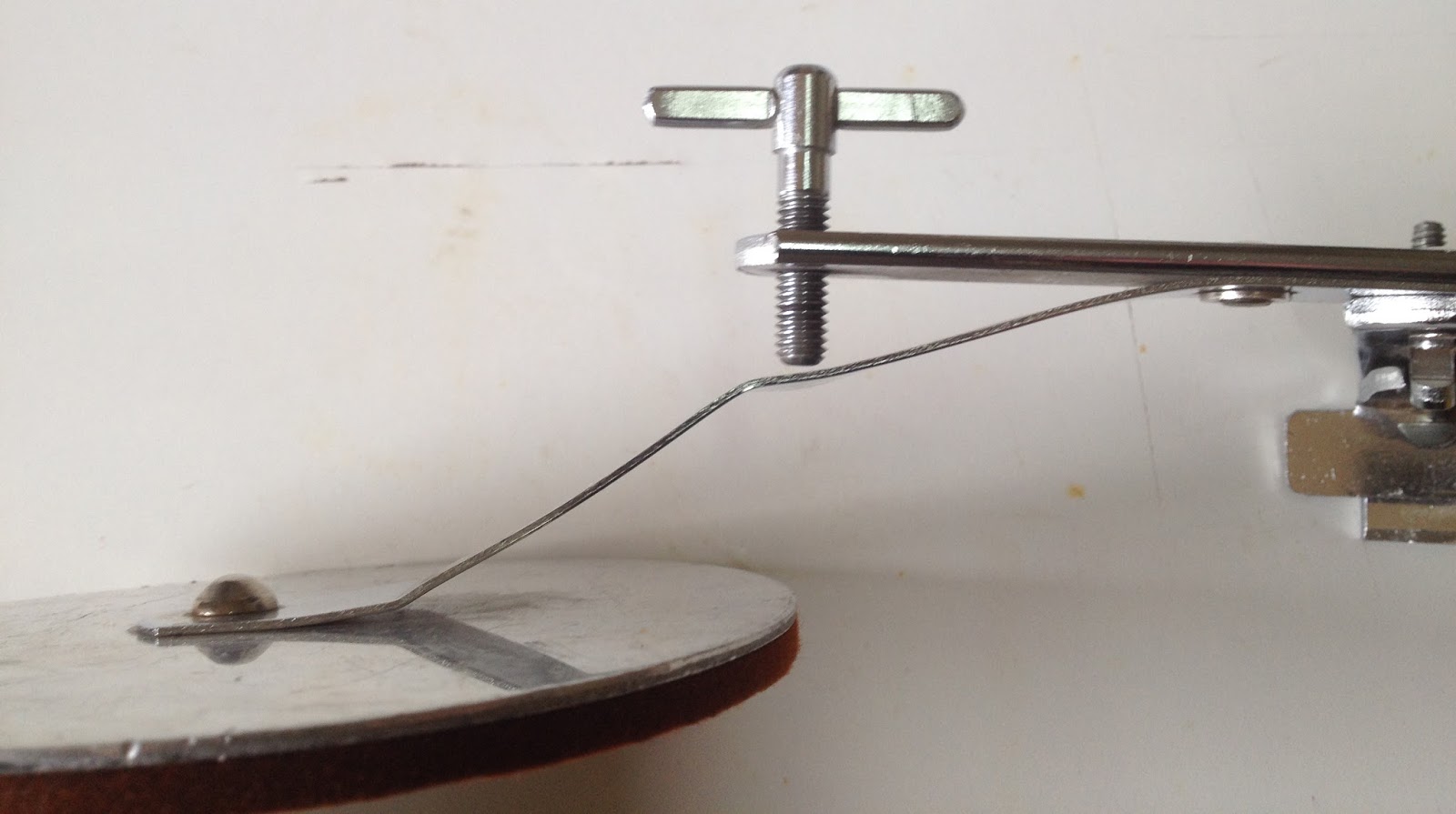
When thinking about solutions trying to solve the problem, get the instrument under control and get the best possible sound, I remembered a device used on vintage drum sets. It is a felt pad attached to a round plate with articulated arms which you can fix to the counterhoop. Using wingnuts you can control the pressure it exerts on the head and where on it (by bending the arm). You could see it mainly on bass drums, as the other drums on the kit used to have it inside.


© late8


I got one a few months ago. My intention was to not necessarily use it on a kit, but I knew that, at some point, it would come very handy for whatever weird purpose my mind would come up with. This is the one. It has no brand or inscription on it. Maybe a Ludwig? It´s 15cm in diametre and its arm is 25cm long. As with everything, you can go the expensive way if you get a vintage, fancy one, but you can get a modern one for a very fair price (STAGG).


© David Valdés


© David Valdés


© David Valdés


© David Valdés


© David Valdés


Here it is on the head, ready for some action.


© David Valdés


The muffler moves together with the head, you can press it more or less against it, there´s no play between them, you can move it closer or away from the counterhoop and it produces no buzz at all. It works flawlessly. Just one thing: its size is intended for bass drums no larger than 24", 26". As symphonic bassses can reach up to 40" in diametre, its surface may be not enough to get the desired effect on instruments this size. I would have loved some more control, but this device can be very easily modified to get more contact surface. Even that, I got rid of the buzz and the bass drum sounded very well.

A calf head is the best option for a bass drum (I think, in fact, it´s the only option) but, if not, the towell trick has proved (quite) its effectiveness. If the towell is giving you a hard time, this muffler is a fantastic solution to play your bass drum not only with control, but with some style...


…et in Arcadia ego.
© David Valdés

Thursday, 10 March 2016

"American in Paris" taxi horns: the end of a historical mistake.

There´s a buzz going through discussion groups and forums these last days that, far from calming down, is growing in a very noticeable way... The subject is not trivial, as it has "huge" consequences. An article in the New York Times reveals that the taxi horns we´ve been using all these years in "An American in Paris" (George Gershwin) were playing the wrong pitches.


© Jam percussion


The article, published on March, 1st (hot from the oven), has left no percussionist indifferent. HERE is a link to it. There you will find the conclusions of Mark Clague, musicologist in charge of the new critical edition of the score.You will also find a recording with the part as we play it today and the first recording of the piece (and the only one featuring the original pitches) by Toscanini and the NBC National Orchestra. Stop reading this blog, open the link and, before going on with Percusize Me!, read the New York Times article. The key is the A, B, C, D notation...
 
Have you already read it? If not, stop now and go for it... Done? Don´t tell me you are not petrified...

The conclusions in the article make much sense, but they gave cause to doubts, discussions and mistrust, as they could not be 100% proved due to the original set of horns being lost and because no photographs could definitely prove the A, B, C, D notation was not one related to musical pitches but to the order in which the horns were arranged for the recording. The commotion and controversy the article created about this "transcendental" issue enriched the debate, but every doubt and opinion got eclipsed when, on March 5th (only four days after the article shocking the Gershwinian foundations was published), the University of Michigan got the ace hiding up its sleeve that proved almost irrefutably its point. The link to that article is HERE. As before, stop reading Percusize Me!: open the link and devour it.


© Ira and Leonore Gershwin Trusts


What do you think? Incredible, isn´t it? This photo is the bombshell that proves we´ve been playing those notes wrong. It´s pretty clear looking at them that the size of the horns is not proportional to consecutive pitches (a, b, c and d), and that they are not even arranged following a size pattern, so the points made by Mark Clague are very valid.

Gershwin himself got those taxi horns during two different trips to Paris, got them arranged on a board the way we can see in the photo and named them A, B, C and D as ordinals, not as pitches. The pitches on the Toscanini recording are A flat, B flat, D (quite brilliant) and A natural (low octave).

Don´t know you, but I´m astonished about this revelation, and the points are valid. This is also the kind of curiosity mixed with academic rigour that, you should already know this, I like so much.

There are rental companies already offering this new set of pitches and percussionists willing to play them in future concerts. I would love to try this new version... What would you do?


…et in Arcadia ego.
© David Valdés

Monday, 15 February 2016

"Do It Yourself" chocalho.

Last February 12th I played in a concert that, to commemorate its 30th anniversary, "Celtas Cortos" (a very popular band in Spain) gave together with the Asturias Symphony Orchestra.

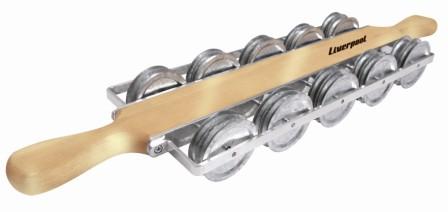
"El Emigrante" ("The Immigrant") is a song including a batucada and, on it, the chocalho (together with surdos and agogo bells) provides the popular samba flavour. This instrument consists of a frame which holds several jingles ("platinelas"), and it´s played shaking it back and forth.


© izzomusical


© totperlaire


CC Wikipedia


The chocalho sounds like this:


As I was assigned this instrument and neither the orchestra nor me had a chocalho, I decide to build one myself. For this I used a squared section wooden strip measuring 18x18mm (I chose those measures because they felt just right in my hand) which I cut to a length which, again, allowed me to hold it confortably and could house enough jingles. 


© David Valdés


Two more small fragments were also cut.


© David Valdés


I rounded the edges with sand paper in order to get a nice feel. In the following photo you can see one fragment sanded and the other one still raw.


© David Valdés


In this photo all strips are sanded.


© David Valdés


Then, I used these plates and screws...


© David Valdés


...to fix the small sections to the large one as handles.


© David Valdés


Once the frame was done, next step was adding the jingles. For this I used bottle caps (being from beer bottles is pure coincidence, I promess... You can get them at your local pub or you can stockpile them as you drink... ;-). Bare in mind my chocalho features 66 of them, so you are gonna have serious fun should you take the DIY philosophy to the bitter end... :-).

 In order to make them sound more lively, I peeled off the plastic at the back.


© David Valdés


Using a hammer they got what they deserved...


© David Valdés


After working on a few of them, I realised it was much easier to hammer them first and then peel the plastic off, so I inverted the order in my "assembly line". Be very careful: my fingers got some hammer blows and cuts.


© David Valdés


I made a hole in the centre (more or less...) using a nail and a hammer (love these subtle procedures!), and then enlarged it using a hand drill.


© David Valdés


Then I made bunches of jingles inserting groups of six (why not five or seven? who knows...) into nails.


© David Valdés


Each bunch was hammered onto the frame with a 7.5cm separation from their colleagues.


© David Valdés


And... Voilà! The chocalho was ready.


© David Valdés


If you are observant (and I bet you are), you can see bunches follow an alternating pattern: they never face with the one on the opposite side. I took this idea from the jingle arrangement on Grover tambourines.


So, this is how my home-made brazilian stravaganza sounds like:


To be honest, despite being made using very cheap and recicled materials, it sounds quite good and produces a more than decent volume. Now you only have to get the DVD to hear it in context.

Have you ever built an instrument using simple, common materials? Tell me, give me ideas, as I´m in the mood for this kind of projects.


…et in Arcadia ego.
© David Valdés

Monday, 11 January 2016

"The timpani and percussion instruments in 19th-century Italy".

Because I´ve been a very good boy during this last year, the Three Wise Men brought me as a present the book "The timpani and percussion instruments in 19th-century Italy", written by Renato Meucci, translated into English by Michael Quinn and edited by Banda Turca.


© Banda Turca


As you already know, I have a sincere interest in timpani parts containing "errors". I have also explained how I deal with them and my interest in historical instruments and historically informed performance. Because of it, reading this book has been a real treat.

This is a 92 pages delicacy which you will devour in no time... Its size is very handy (so you can carry it on your stick bag for reference), paperbacked, printed on quality paper and uses a very appealing type, making for a very nice reading.

Already on the preface, the author gives us some tasty pills (the italian orchestra and its components as "singers" who play their instruments the same way as a singer would use his/her voice -thus the endurance of three stringed basses, concertmasters conducting from their desk, "peculiar" flutes and clarinets, performance practices in the percussion section already obsolete north of the Alps...-), and what follows is a vast amount of very detailed information, documented with many footnotes

So, there´s a chapter dedicated to timpani, the different models built at that time (I already mentioned some of them and also cited Antonio Boracchi on "Editing timpani parts" I, II and III ), performance practices, notation (which also entails technique, with things like striking one drum with both hands simultaneously or press rolls) and "wrong notes".

Another chapter deals with the Banda Turca, and reveals many interesting issues, like the very improvisatory and open character of the parts, the "ad líbitum" orchestration of the section, the concept behind sistri (which makes me suspect some editions requesting "sistro" may well be wrong) and the inherent flexibility of the percussion forces when it comes to augment or diminish them depending on the available musicians at the theatre playing those works.

The author then explains single instruments in detail: the snare drum, the tenor drum (which, even then, was regularly mistaken and, like I explained on "The tenor drum: the great unknown", it is still the case nowadays), the bass drum, cymbals (making clear that what we now think was the norm -playing "alla turca"- was not regular practice nor an accepted one by composers/conductors), the triangle, the bell lyra, the jingle Johnny, the tam-tam and the glass harmonica (who can now convince flautists that their big solo in the mad scene in "Lucia the Lammermoor"  was not written for them, but originally intended for this exotic instrument!).

The book is completed with an appendix, a vast and very detailed bibiliography and very interesting illustrations.

The only objection I find in this book is that it doesn´t clarify something I´m really interested in: how Italian timpanists dealt with "wrong notes"... Other authors like Blades ("Percussion instruments and their history") and Pfundt ("Die Pauken") make clear that it was common practice to change them. Notes were amended in the United Kingdom and Germany, and I´m conviced Italy was not an exception (I was lucky to have lessons with David Searcy -La Scala- and have talked with Riccardo Muti about this issue, and both confirm it was common practice). I´m convinced Italian timpanists changed "wrong notes" (they had the knowledge and the instruments), but the author doesn´t dig deep and leaves me with the feeling of wanting to know more. 

I´m also not convinced about the chapter on the tam-tam, which is very short and doesn´t clarify much (specially with regard to the measurements of the instruments of that period).

Despite these two tiny spots, the book is magnificent, and I strongly recommend it to anyone interested in enriching his/her percusive vocabulary, whether he/she is going to apply these ideas to his/her day to day orchestral work or not. Definitely, this book will be a great influence on my future musical decisions when it comes to playing Italian repertory form the 19th century.

You can buy it online on www.bandaturca.com at the equivalent of 26 Swiss Francs. If I were you, I would buy it now.


…et in Arcadia ego.
© David Valdés

Tuesday, 22 September 2015

The tenor drum: the great unknown.

The tenor drum is an instrument not very well know: even seasoned percussionists mistake it for the military drum, another member of the percusive family. This article will define its characteristics and make clear what instrument it is.

At first I thought this article would make not much sense in the UK or the USA, where the tenor drum is widely used and has an important tradition, but I could see in different Facebook groups that, even in those countries, percussionists tend to confuse between different instruments.

Sadly, when a composer orchestrates for tenor drum, the usual thing is to play on the wrong kind of instrument, as percussionists tend to not know it or to mistake the tenor drum for the military drum, two completely different animals...

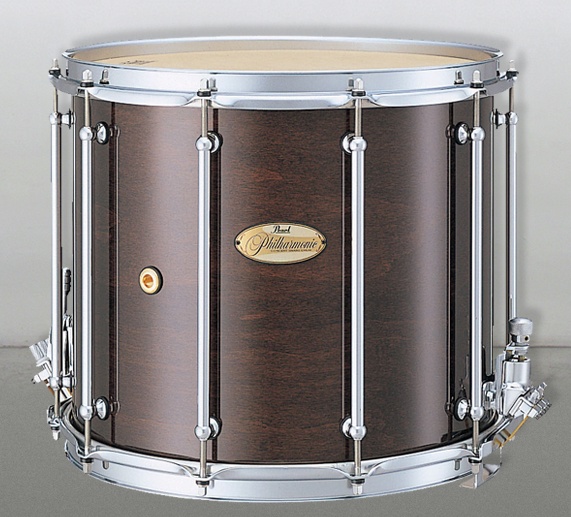
A military drum or field drum is a drum between 14" and 16" in diametre, between 8" and 16" in depth (this obviously depends on the model, maker and sound we are after) which FEATURES SNARES. It´s the kind of drum that, since the Middle Age, has been used by the infantry to help soldiers march and communicate different signals in the battle field.


© Pearl Drums


The sticks we use to play it are almost the same as those we use on the snare drum, sometimes larger and heavier to get a greater volume and to "excite" this bigger instrument.


© Cooperman


A tenor drum can be of up to 18" in diametre and depth. This drum features NO SNARES.

As with other instrumental families (trombones, for example, which can be "alto", "tenor" and "bass"), we can consider the tenor drum as the highest member ot the bass drum family, this last one being the instrument to which the tenor drum is, in fact, related (we can consider the tenor drum as an "alto bass drum" because of the lack of snares, the kind of mallets used on it and the writing and use composers make of it, which make of  the tenor drum an instrument much closely related to bass drums than to snare drums).


© Pearl Drums


In addition, the tenor drum is played with mallets completely different to those used on snare drums or military drums, the heads much bigger and softer, like those we would use on bass drums or timpani.


© Pearl Drums


Of course, and because historical instruments are now very much "in vogue", both the military and tenor drums can feature skin heads, gut snares (in the case of the military drum) and be rope tensioned.


© Cooperman
© Lefima


The misunderstanding can come from the reason that, sometimes, composers use equally both "tenor drum" and "military drum", but the vast majority of them know the difference, so we cannot think "anything goes" and play a military drum when it should be a tenor. A good composer knows the difference, a mediocre one may not... When in doubt, ask the composer and, if he is wrong, you´ll be making him and the profession a favour by politely educating him. 

We can find the tenor drum in works by Bernstein, Copland, Schuman, Walton, Tippett, Bennett, Britten...

I´m going to use a specific work to ilustrate the use of this instrument: Benjamin Britten´s "War Requiem".

On its first intervention ("Dies Irae"), Britten writes nothing about what sticks to use on the tenor drum, as he takes for granted the percussionist in charge knows the instrument and what mallets to use.


Later on ("Ofertorio"), we can find an indication on the part stating "SD sticks". That is: Britten is indicating an exception (in this case the tenor drum does not roll, it loses its sombre character and doubles the orchestral hits... A change of sticks is quite logical).


This indication makes us realize that snare drum sticks on the tenor drum are an exception: this drum is played with mallets like those I showed you before. Britten indicates nothing at the beggining because he supposes the percussionist knows what sticks to use, and when he wants a different effect, he asks the player for a different one: SD sticks. It´s the same as when a composer asks for the triangle to be hit with a xilophone stick or a cymbal to be struck with a triangle beater: only the exception is indicated. In the case of the tenor drum, the exception (clearly indicated by Britten on the score) is to use snare drum sticks.

In the following passage ("Libera Me"), a dialogue is stablished between the bass drum and the tenor drum, which should make us realize that both instruments are closely related. It´s a dialogue between equals, not between contrastating instruments. 


Here, Britten is playing with two dark and sombre colours (he will add a third one later on), one higher than the other so they can be differenciated, but very closely related in character and timbre. A drum with snares and played with snare drum sticks makes no sense in this passage, as we would be breaking the coherence and character: we are talking about a tenor drum here, not a military one.

Another clue about the proper mallets on the tenor drums is that, on that same passage, the snare drum joining some bars later is asked to be played "without snares" and with "felt sticks". See also the penultimate system on the previous photo.


Here we have three instruments taking up the low, mid and high frecuency bands (bass drum, tenor and snare) played with the same kind of mallet (obviously, Britten doesn´t indicate what kind of stick to use on the bass and tenor part, as the player knows what to hit the drum with: it´s only the exception on the snare drum that is indicated so it can match the timbre of the other two by playing with felt sticks and no snares).

In addition, we know that, as a mourning effect, drums have traditionally played "coperti", that is, covered or without snares. This passage is clearly a funeral march (do I have to remind you we are talking about a "Requiem"?), so snares make no sense at all in this context. When the snare drum joins the funeral march, guess what? it does so without snares and with felt sticks so as to match the other two instruments. Obviously, no "without snares" indication is on the tenor drum part, as it´s on its nature no to feature them.

To clearly see the relation between the bass drum and tenor, we can see that, as it happened before with the tenor being asked to be played with snare drum sticks for a special effect, Britten asks for that same effect on the bass drum at some point. That is, the same kind of effect using snare drum sticks is requested on two related instruments from the same family and character.


Again, as it happened with the tenor drum, an exception (snare drum sticks) is indicated, as we all know which "regular" sticks to use on bass drum. When two instruments regularly struck with soft beaters (bass and tenor) are asked for a special effect, Britten asks for snare drum sticks, and when a instrument regularly struck with snare drum sticks (obviously the snare drum!) is asked for a special effect, Britten asks for felt sticks (in this case, to match the other two instruments). It should start to become clear wich instruments are related, which are not, which features snares and which not, what sticks to use... Shouldn´t it? ;-)

Before we finish, I´d like to clarify a technical issue... A roll on the tenor drum is played exactly the same as on a bass drum or on timpani: hand to hand, no rebounds. This can do nothing but to confirm that its relationship is with the bass drum, not with the snare drum.

If you are still tempted to use a military drum instead of a tenor or to play with snares an instrument which doesn´t feature them, you just have to listen to the recording Britten conducted for DECCA in 1963 featuring the London Symphony Orchestra, where we can hear the tenor drum has no snares and produces a deep and sombre timbre with the proper mallets.


© DECCA
     

Apart from the English "Tenor Drum", this instrument is know as "Tambor Tenor" in Spanish, "Caisse Roulante" in French, "Ruhrtrommel" in German and "Tamburo Rullante" in Italian.

So, next time you are asked to play a tenor drum, you´ll have enough arguments to choose the right instrument.


…et in Arcadia ego.
© David Valdés