Wednesday, 26 September 2012

New website.

New article on Percusize Me! after a period of inactivity. It is not that I´m getting lazy with my blogging, but there have been certain issues during the summer that kept me away from Percusize Me! One of them is me practising timpani like crazy, and it seems that practise has payed back, and will write about it in the future. The other, and the reason of this article, is that my website has been fully redesigned.

The site has a new design, new sections, the blog has been integrated, and surfing has been made much easier. I´m really excited about it, and I hope you find it useful.

Here is David Valdes new website.


© David Valdés

Have a look at it, and don´t hesitate to contact should you want to suggest someting.


…et in Arcadia ego.
© David Valdés

Saturday, 7 July 2012

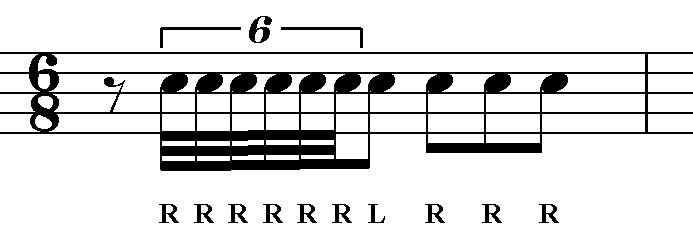
Various stickings for "Scheherezade".

Sometime ago I showed you a one-handed way to play the third movement of "Scheherezade". That article was "Snare drum technique VI. One-handed Scheherezade".

After recording that video, I tought I should try that excerpt using different stickings. You can see the result on the following:


These are the different options (in order of appearance):


© David Valdés


Obviously, these stickings can be reversed if you are left handed and convert rights into lefts and viceversa.

I decided to play the last three eighth notes with my strong hand (right one) in order to get the best rhythmical and timbrical homogeneity, but they can be played with different combinations: RRL, RLL, RLR... (and all their right/left inversions).

Every single sticking showed on the video produces a different phrasing, providing us with many different options when it comes to making music. That, and no other, is the purpose of technique: a mean to get to a musical solution that suits best a particular context.

Which sticking are you using for this famous excerpt?


…et in Arcadia ego.
© David Valdés

Tuesday, 3 July 2012

Boston Magazine. The Audition.

New entry after almost two months without writing. I love managing Percusize Me! and tlike offering my readers articles or opinions of their interest but, if you are a follower, you may already know about my passion for the sea and navigation: this is what has kept me away from you for a while. Recently, I took my exam for becoming the Spanish equivalent of an Yachtmaster Ocean and, being the exams quite hard, the time devoted to study didn´t allow me to update Percusize Me! as often as I would have like. Everything is more calmed now (and my exams have been a total success!), so I can retake the blog with renovated energies.

Today I´m bringing an article which, in my opinion, is devastating. On it, Mike Tetreault (my mate at the Royal Academy of Music for two years) explains how he prepares an audtion, how a friend of him is sacked after three years with the Boston Symphony, how the hard preparation doesn´t even take to the second round, his wishes, his frustrations, the fairness or unfairness of a system looking for machines instead of musicians... I felt so identified with him, that thought I had to share it with you. Here´s the link where you can read it:


What is a fair system for auditions? Starting with the fact that percussion audtions are quite ridiculous due to percussionists been asked to play orchestral excerpts totally out of context and with no accompaniment, this is where I see the first mistake. I only played once with piano accompaniment ("Rosenkavalier" timpani part), and only once was I able to play with other musicians (all the percussion section plus piano accompaniment in a memorable Royal Opera House audition). If our job is to play, accompany and make music together with other instrumentalists, to play excerpts by themselves is, at least, bizarre. Having said this, I don´t mean I like the French way, a system which asks for pieces featuring 15 cowbells, 9 toms, 7 woodblocks, tambourine, snare drum and five timpani with piano accompaniment... I will never understand why this kind of solo works are asked for an orchestral audition. It is as if you were attending a job interview to gain a mechanic post and you were asked to cook some spaghetti...


Does a screen assure a fair audition? It depends on the case... I´m really suspicous about the last auditions I played behind a curtain; on the contrary, I have very nice memories of those I played in Rotterdam and Manchester. The one I won in Lisbon was behind screen, but that´s a loooooooooong story, and the one I won in Tallin was also behind screen, but that´s, again, another horror story... A behind the screen audition ensures no discrimination by reasons of race, sex or any other condition is taken (go and talk to the female trombonist under Celibidache in the Munich Philharmonic...!). I don´t dislike this option, but would never (in the case of being in the panel) ask for it in the finals: I would like to see the player, his attitude, commitment, style... In the same way, as a candidate, I want to show those qualities to the panel, so I prefer a final round with no screen. This system is not perfect, and it can be biased towards the candidate prefered by the panel. 

The trials method favoured by the British, in which various people "win" the audition and are tested trough a variable period of time, is a favourite of mine. A post in an orchestra, in my opinion, cannot be granted just by playing isolated excerpts: is for this reason that British orchestras "try" those who have played a good audition. Checking how they do in "real situation", they employ a good musican, not a mere "excerpt player".

Nowadays, with everybody using Facebook to advertise their success, I consider Mike Tetreault and Lee Vison to be two very brave musicians, as they had enough balls to say "I haven´t win". The "everything is fine", "I´m doing very well" attitude is easy, but the honest one, admitting "I didn´t get to the second round", or "I´m not giging very much", is the brave one. I really wish them all the best.

This auditions issue can be lengthy, but it´s something that will come out on this blog in the future. For now, I´d like to read your opinions about it.

I, for now, will quote a phrase in the article:  "Give me success or take this desire away from me. One of the two". 


…et in Arcadia ego.
© David Valdés

Friday, 11 May 2012

Tambourine technique V. Rolls.

New article, this time retaking an issue related to tambourine, as asked by one of the followers of Percusize Me!

There are many excerpts requiring differents types of rolls depending on dynamics, musical context...Shake or finger roll: possibilities are allmost endless, and I´m showing you a few of the many options:


The first roll is the traditional shake one, suitable for the majority of the situations. My advice is to practice it very relaxed.

The second one is a variation producing a triplet feeling. You can get the effect using the movement you use when playing single alternating strokes on marimba.

For piano and light passages, the third roll is your best option. Believe or not, I´ve used it quite a few times.

The nightmare every percussionist fears is to play a piano roll and then making a crescendo: the way I´ve found to give the roll a very clear beggining and articulation is to use the previous technique,  and then play the shake. As a result, we get a very clear initial articulation, pianissimo, and the we can do a nice crescendo.

The two handed version allows great volume and a busy roll, also permiting a clear beggining and ending.

Leaning the fingers against the head we can play very long rolls without fatigue, with a very articulate beggining and ending.

But, if we want a very long and piano roll (Shostakovich 2nd Cello Concerto comes to mind) using a riq technique is the best option.

Finally, finger rolls. We should be able to use all of them, depending on dynamics and character we are looking for.

These are just a few of the many possible options. You know I like tambourine, so more techniques will be shown in the near future.

Let me know your techniques and tricks, and I´ll be more than happy to include them in my arsenal.


…et in Arcadia ego.
© David Valdés

Sunday, 18 March 2012

Snare drum technique VI. One-handed Scheherezade.

Some weeks ago I saw a video by Tony Ames (principal percussion with the National Symphony Orchestra) which got my attention. That video feautures him playing the famous snare drum excerpt from the third movement of "Scheherezade" using just one hand.

You know I always try anything that can lead to a technical improvement or entails a new music making possibility. I try and work on it until I get something that wasn´t previously in my musical arsenal. Any new option is more than welcome.

As always, and before going on, here´s the part we are dealing with:


And here´s my one-handed interpretation, emulating Tony Ames:


This solution is a very interesting one, as we get a very atractive phrasing: the seven stroke roll is nicely tapered down, resulting in a very elegant and musical diminuendo. Also, the hand alternation can´t be heard, making for a very homogeneous phrasing.

Despite what it may seem, it´s not difficult to play (if we know how to get it). In my previous article "Snare drum technique: the roll" , I wrote about rebound control, and showed a video on which I was getting eight controlled rebounds. Put into context, what I´m doing here is getting a six stroke controlled rebound with my right hand, finishing it with my left one to complete the seven stroke roll and, again, use my right hand to strike the remaining three eight notes of the bar. I´m also using a "trick" I explained in the above mentioned article: I´m moving horizontally across the head in order to facilitate bouncing but, if you noticed it, I´m not moving my stick as much as Mr. Ames does, and I´m moving it more in a diagonal line instead of "vertically", trying not to get an evident timbrical change.

Moved by curiosity, I wanted to check if there was visual corespondence with what I heard and, using an audio editor, the graphic result of this one-handed "Scheherezade" is a follows (bare in mind we have a double wave because the audio was recorded in stereo):


© David Valdés


We can clearly see every single stroke of our seven stroke roll, together with a progresive diminuendo (see the amplitude of each wave is smaller than the preceding one). We should not hear with our eyes, but it´s always a relief to visually confirm our hearing impression.

I´d like to know your opinion on the musical effect this way of playing results in. I will soon post an article on the many ways this famous excerpt can be played.

Give me your opinion!, Let me know!


…et in Arcadia ego.
© David Valdés

Tuesday, 14 February 2012

Snare drum technique: the Paradiddle.

Some months ago (exactly last summer, as you will see me on the video wearing a t-shirt and tanned), one of the Percusize Me! followers asked me about the paradiddle. At that time I shot a video explaining some of my thoughts, but couldn´t upload it because my PC was running short of RAM and I could not render long HD projects.

Fortunately, after a good cleaning, an OS change, and some "steroidic" diet based on RAM modules, I can retake old projects that were left for better occasion.

In my modest opinion, not many people understand drum rudiments, what they are, what they are for, and how to practise them. Despite rudiments have been with us for centuries (first rudiments were introduced in medieval Switzerland), there are still doubts, myths and missconceptions on how to play them.

Trying to explain my thoughts on the paradiddle, I shot the following video:


Think of rudiments as a very powerful musical, independence, phrasing, rebound control, and use of inertia tool. If you see them as mere hand combinations, you would have understood nothing.

If rudiments have been with us for so long..., let´s practise them the way they deserve!


…et in Arcadia ego.
© David Valdés

Wednesday, 8 February 2012

Snare drum technique: the roll.

Probably, the roll is the most characteristic and idiomatic of all snare drum techniques. I always tell my students we don´t have a bow or an air column allowing us to play long notes: isolately played, a 64th note lasts the same as a whole note on a snare drum. Thus, the roll  is the only way we can create the ilusion of a sustained sound.

A good rolling technique resulting in a good music making tool is a must. The sad thing is that, despite the roll being a basic technique, there are still wrong ideas and concepts arround it.

Trying to explain my thoughts on the roll, how I analyze it, the way I improved mine, and how I work to control the number of rebounds, I have shot this video:


Aplying the concept of the "Triple Stroke Roll" rudiment has been fundamental in order to improve my roll. I hope you find this video helpful.

As always, any comment helping me to become a better musician will be more than welcome. Anxiously waiting for them!


…et in Arcadia ego.
© David Valdés